H. G. Dietz
http://aggregate.org/hankd/
Department of Electrical and Computer Engineering
Center for Visualization & Virtual Environments
University of Kentucky, Lexington, KY 40506-0046
Initial release: September 16, 2010
Latest update: February 9, 2026
This document should be cited using something like the bibtex entry:
@techreport{mylenses20100916,
author={Henry Gordon Dietz},
title={{My Lenses}},
month={September},
day={16},
year={2010},
institution={University of Kentucky},
howpublished={Aggregate.Org online technical report},
URL={http://aggregate.org/DIT/MYLENSES/}
}
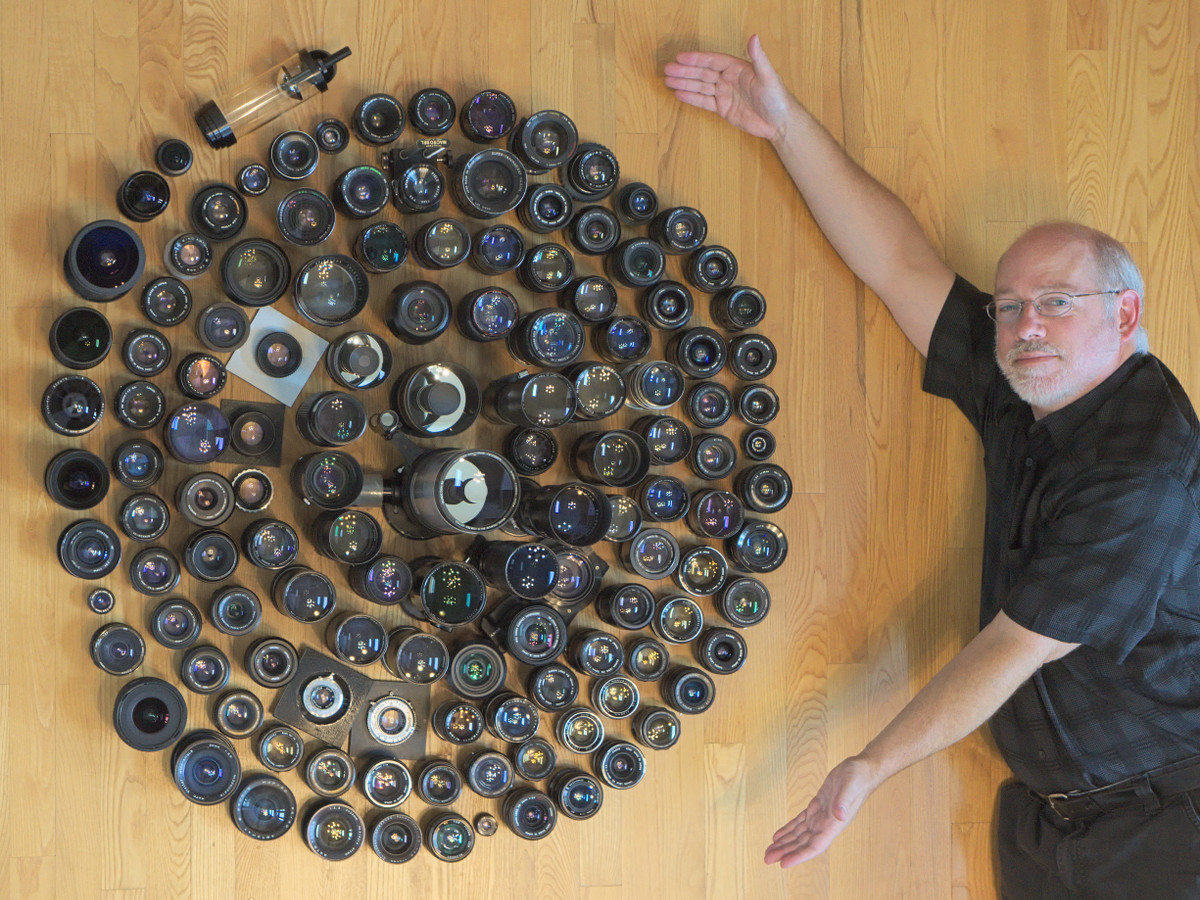
This document is a summary of the lenses that I, Professor Hank Dietz, had or have either personally or for my research at the University of Kentucky. The photo above is a nice sampling of my collection as of July 2014. The opinions expressed here are my own and should not be construed as anything more than that -- my opinions. In most cases, rather than commenting here, I've linked to where my reviews are posted along with others.
As a community service, I have tried to describe my lenses in a way that will allow others to easily judge their appropriateness for various kinds of uses. Toward that goal, I list several key attributes.
Of course, nearly every lens is best in some way... but the
truth is some are built better or simply perform better
optically under most circumstances. Very informally, the entries
here are marked with a minimal evaluation of quality in three
dimensions:
Build quality:
 D
D
 C
C
 B
B
 A
A
 best-in-class
Image quality on APS-C:
 D
D
 C
C
 B
B
 A
A
 best-in-class
Image quality on APS-C using a focal reducer (e.g., Lens Turbo):
 D
D
 C
C
 B
B
 A
A
 best-in-class
Image quality on Full Frame (e.g., Sony A7):
 D
D
 C
C
 B
B
 A
A
 best-in-class
Why do I distinguish APS-C, APS-C with focal reducer, and full frame?
Because performance of many lenses is very different
(with the same 24MP total sensor resolution)
for these three ways to use the same lens.
APS-C renderings tend to be very even, but many lenses cannot quite
resolve well enough for 24MP APS-C.
Focal reducers typically increase center resolution, but the optical
flaws of the reducer can magnify or compensate for optical defects
such as field curvature.
The result is often somewhat poorer corners, but getting crisp
corners stopped down can still earn
a B or A.
Full-frame sensors suck-in even a bit more of the lens coverage than
you get with a focal reducer, often revealing corner issues (most often,
vignetting), but delivering really excellent central IQ.
In sum, a lens can be great on one format and terrible on another,
so be aware of which ratings matter most to you.
Of course, these ratings are highly subjective. I have even been known to change a rating or two as I've gotten more experience with more lenses. On the line after some lenses, I have listed some significant points about them. Usually, if there's something odd about the lens, it will be noted there. These are not full reviews, but notable features or issues.
With a fair number of 44x33mm cameras now getting into the consumer price range, and the extremely cheap option of capturing 48x36mm three-image-stitches using the Budgie M-to-E shift adapter, coverage circle is becoming relevant even for designed-for-FF lenses. The frame diagonal is 43.3mm for a FF lens intended to cover 36x24mm, 55mm for 44x33mm, and 60mm for 48x36mm (i.e., Budgie) or 50.9mm for a 36x36mm square crop, but most lenses cover somewhat larger diameter circles than the diagonal of the format for which they were designed.
Measuring coverage is difficult because it depends on focus distance and aperture, but also because shedding light on an area isn't the same thing as saying there is high-quality image detail painted there. There is also the fact that tiny amounts of decentering could cause a change in the usable coverage circle, so even apparently identical lens copies might vary significantly. I am currently using Budgie on a Sony A7RII to measure coverage circle, which might also introduce some imprecision. I shoot a frame with the lens maximally offset on Budgie, which means one edge is in the center, and then I simply measure the distance from the center of that edge to where the image circle intersects the frame edges -- which should average out to the radius. Since the A7RII resolves approximately 7952 pixels in 36mm, I simply multiply the sum of the radius measures by 36/7952 to get the coverage circle diameter in mm, and I round that to the nearest integer value. I can't measure coverages greater than 60mm this way, but almost no FF lenses quite make it to 60mm (at non-close-up focus distances); typical numbers are in the low 50s.
As of Spring 2023, I've started adding coverage estimates in the form of a pair of numbers each prefixed by an H, M, or S. For example, (S46,M48) means that wide open this lens very Softly tapers off to a 46mm diameter coverage and stopped down to the smallest aperture (largest f/number) it has a Moderately sharp approach to vignetting at 48mm diameter coverage. A lens that very suddenly and sharply vignettes, showing a clear line at the coverage edge, will be designated as Hard vignetting. Of course, these numbers are approximate and should be taken only as "ballpark" estimates; use them at your own risk.
Significantly less subjective, but no less controversial, is radioactivity. Yeah, that scary thing that happens when lenses use the wrong heavy metal dopants to make the glass for some lens elements. You know adding lead to glass helps keep light from breaking into rainbows, i.e., it reduces the dispersion: the change in index of refraction with wavelength. Well, using as much a 40% of a heavy metal additive generally has that desirable effect, and radioactive metals like Thorium and even Uranium were often used until they were banned. They were eventually banned for endangering the folks who make and shape the glass, because inhaling the radioactive dust is definitely bad; however, the lenses were never recalled because most aren't particularly dangerous in normal use. Of course, that instantly makes you want to know which are the dangerous ones...
Perhaps the most complete list of lens radioactivity measurements is a site written in Swedish; there's also this list at Camerapedia. There are three types of emissions, in order of increasing concern: Alpha (α), Beta (β), and Gamma (γ). Over time, most radioactive materials will end up emitting all three in some proportion, because radioactive elements decay into other radioactive elements with different emissions. Most cheap Geiger counters can't even measure α because they can't make it through the thin plastic case of the meter, whereas γ pass freely through most metals and can do a lot more damage. My GQ GMC-320Plus is a relatively low-end Geiger counter that is sensitive to both β and γ, but I can roughly isolate the γ by using aluminum foil to block the β. Of course, distance reduces the radiation level seen from a small source. Then again, background radiation isn't zero either, and between 0.1μSv/h and 0.2μSv/h is normal at sea level. I'll only measure lenses that seem likely to be radioactive either by reputation or by a quick scan over all my lenses with the Geiger counter.
Here, I'll simply list the β+γ μSv/h as: <1.0μSv/h, ≥1.0μSv/h, and ≥10.0μSv/h. I'll list CPM and μSv/h values with a ":" between them for front and back of the lens measurements with the Geiger counter sitting directly on the lens, and I'll give a (partial) lens serial number. Counts vary over time, so I'll list the maximum I saw or not radioactive if that was "background level." For reference, exposure to radiation increases with altitude, so flying in a jet is around 7μSv/h... so don't panic about the lower numbers. Still, there is always some risk with radiation, so keeping a little distance (e.g., at least a few feet) between you and your radioactive lenses while you're not using them is probably smart.
Lens mounts are identified as:
C-mount (TV, video, movie, industrial lenses):

Canon (manual focus):
 FL,
FL,
 FD,
FD,
 FDn (the bayonet version)
Canon (autofocus):
 EF (EOS full frame)
Exakta:
 Exakta / RE Topcon
Kiev:
 Kiev-10 / Kiev-15 (the one with no commercial adapters)
Konica:
 Konica AR
M39:
 M39, Leica, L39 (1mm pitch, but 0.75mm pitch for some enlarger lenses)
M42:
 Preset,
 Auto/Man,
 Auto
Auto
Minolta (manual focus):
 SR,
SR,
 MC,
MC,
 MD
MD
Olympus OM (manual focus):
 SR,
SR,
Sony Alpha (auto focus):
 A (also Minolta MA),
 E (also FE full frame)
Tamron:
 Tamron Adaptall-2 (improved Adaptall)
42mm x 0.75mm thread with 55mm register (various manufacturers):
 T and T2,
 YS (Yamaki Spira/Sigma allows auto aperture)
Topcon:
 UV
Exakta / RE Topcon
UV
Exakta / RE Topcon
Nikon:
 F
F
There are really just three "levels" of sophistication of lens
mount. Originally, lens mounts simply provided a way to fix the
lens to the body. Next, automatic stop-down of the lens when
the shutter button is pressed was the big feature -- and it also
required transmitting information about the
selected-but-not-yet-applied aperture setting from the lens to
the body. The fanciest mounts allow autofocus driven from the
camera; many such mounts also implement much of the control
electronically rather than mechanically. Note that using lenses
with alien mounts on modern digital cameras generally means
functionality goes back to the simplest level. Although there is
nothing preventing, for example, an
adapter to from providing full
auto-aperture control, it seems that nobody has commercially
marketed such an adapter... yet?
As a reference as to how exotic each lens is, I have also noted the approximate pricing of the lenses. The notation is [$original in year; $what_I_paid in year]. The original numbers are highly unreliable, scrounged from various WWW sites, but they are interesting. Original price references include: Third Party Lenses, Canon Camera prices 1970s, Canon FD 1986 price list, Ad from January 1987 Popular Photography, B&H Canon FD price list August 1992, various Minolta price lists, Minolta Maxxum, Minolta AF lenses, 1971 Pentax retail prices pages 1, 2, and 3, Sony/Minolta AF lens price guide. Yes, there are large price differences between different sources; that should be no surprise to anyone who has ever shopped for a lens. Many of my purchases were about getting a quantity of lenses for my experiments rather than about getting specific lenses. I have sometimes overpaid when getting specifc lenses I wanted (most notably the Vivitar Q-DOS), whereas many of the lenses I didn't seek out were exceptional bargains.
There are a few other notable references on the WWW. For example, various old lens reviews from when they were new were scanned from Modern Photography. There are also various serial-number guides, such as this decoding of Kodak manufacture dates to this list of who manufactured various Vivitar lenses.
Although I think that fisheye lenses are uniquely well suited for various uses (for example, most of the images I capture under computer control are through various forms of fisheye lenses), fisheye lenses are definitely considered special-purpose by most photographers. The result is that they tend to be expensive. Often, the lenses are implemented as converters, perhaps because that allows use with a wide range of cameras without having to manufacture many different mounts. The best converters certainly seem to produce images that compete well with the best prime lens implementations, although the best converters are at least as expensive as prime fisheye lenses. In general, cheap fisheyes have poorer image quality around the edges, often with poor sharpness and color fringing, but it also is common that vignetting makes the official view angle a potentially serious overstatement of what's really imaged. I actually use $4 door peepholes as fisheye converters for webcams, but keep in mind that their optical quality is barely good enough for even a sub-megapixel webcam and yields a view angle that is far less than advertised for the peephole (e.g., 220 degress becomes 170 degrees). It is also useful to point-out that centering of fisheye lenses is often poor, and even well-centered fisheyes can use any of several diffierent projection formulas, so de-fishing typically requires calibration in order to achieve the best accuracy.
Opteka 6.5mm f/3.5 () [$150 in 2015]
not radioactive #128?
Spiratone Fisheye 7mm f/5.6 () [; $58 in 2018]
No focus, less than 180 degrees,
smeary near the edges of the circle but pleasantly black outside the image circle;
it's really a C in IQ but gets a B- for style
not radioactive #103??
Accura 12mm f/8 () [$225 in 1968; $65 in 2010]
not radioactive #1640???
Minolta MC Fish-Eye Rokkor-X 16mm f/2.8 () [; $299 in 2017]
A well-respected classic with built-in (rotate) filters.
Decent flare resistance, sharp in the middle from f/2.8,
but edges improve with stopping down and there is easy-to-fix
CA (red channel is too big).
Veentook Osino Magnetic 180-degree Fish Eye Lens (magnetic ring) [$3 in 2013]
Decent IQ; clips circle on Samsung S3, nice rectangular fisheye on D-Link DCS-930L;
overall, resolves about 1-3MP
Generic Magnetic 180-degree Fish Eye Lens (magnetic ring) [$2.30 in 2015]
Same as Veentook Osino, but came in set with close-up and wide for $2.30;
close-up and wide are not as good
Generic Jelly Lens Fish Eye Wide Angle [$0.79 in 2015]
Glass (?) lens with reusable sticky green plastic mount;
gives fisheye view with low contrast and uneven distortion, resolves less than 1MP
Deltana Super Wide Angle Door Viewer (special mount) [$4 in 2006]
Claims 200 degree, but really 175; resolves 1-2MP on a small-diameter lens
FIT Ultra Wide Converter Lens F.A.=185 degrees (special mount, special mount)
Farily sharp 185 degree on an Olympus D340-R; works well literally stuck to the front of a Canon PowerShot
Nikon Fisheye Converter FC-E8 0.21x (28mm & 52mm filter thread)
Farily sharp 185 degree on a Nikon 950; not so sharp in front of an SLR lens
Raynox DCR-CF185PRO High-Definition Fish Eye Conversion Lens (various filter thread)
Very good quality on nearly any host lens, but weight stresses filter mount and autofocus motor
not radioactive #529??
Spiratone Auxiliary Fish-Eye Lens (52mm filter thread)
Should give great quality, and does on a fast 50, but is picky about host lens and gives an awkward crop on APS-C with a 50mm
Spiratone Birds Eye Attachment (Series VII filter thread) [; $123 in 2011]
Very well designed and built including threaded positioning rod for the mirror
and close-up filter to aid focus on the mirror;
outer glass has reflection issues and IQ is disappointing (roughly C+),
but it is as good as this type of reflector optic gets
Wide-angle lenses for SLRs need to have a longer gap between their rear element and the film/sensor than their focal length... which means that they tend to be retrofocal designs that can be thought of as combining a simple wide angle with an inverted telephoto to reproject the image. In other words, they have lots of elements. That's an unhappy thing for older lenses that predate good coatings, because contrast can be lost on diffuse internal reflections. Because design of ultra-wides is hard, pre-computer-design lenses generally don't get too wide... especially when used on APS-C or 4/3 crop sensors.
Cosmicar TV Pinhole Lens 9mm f/3.4 () [; $15 in 2019]
Delivers no more than 4MP in a 13mm image circle,
but can use as a wide angle probe lens and focus by partial unscrewing
Opteka 15mm f/4 LD UNC AL f/4 () [$130 in 2019]
Clone without shift mount of Venus Optics / Laowa 15mm f/4 1:1 macro;
needs >0.5mm shim to get infinity right
Pentax-110 18mm f/2.8 (Pentax-110 mount) [; $20 in 2013]
Tiny! Covers APS-C fairly well, but IQ falls off in corners
664 CPM 4.3μSv/h : 588 CPM 3.8μSv/h #711???
Spiratone YS 18mm f/3.5 (:) [$170 in 1977; $60 in 2011]
Nice try, but the IQ just doesn't cut it, especially full frame
dark corners and blurry edges; it does focus pretty close and is
better close, with swirly bokeh
(M44,H47)
Vivitar 19mm f/3.8 () [; $10 in 2011]
Not better than an APS-C kit zoom;
good on FF, but gentle vignetting and LOTS of field curvature;
my review at DPReview
Mir 20 20mm f/3.5 () [; $10 in 2012]
See Instructable on Kiev 10/15 mount;
really quite a good optic... would probably be reasonably compelling on full-frame
(H44,H45)
Auto Vivitar 20mm f/3.8 (, ) [$225 in 1970]
Yet another sticky aperture lens -- both copies, although one still moves (slowly);
a lot like the Mir 20, also with good close focus
(M46,H48)
Vivitar 24mm f/2 () [$160 in 1976; $40 in 2010]
Good but slightly glowy lens with classic Kiron stuck-open aperture problem, temporarily fixed by tighter spring
(M54,H54)
Canon FD 24mm f/2.8 S.S.C. () [$287 in 1986]
Although this lens doesn't have a strong reputation, this copy has shockingly good IQ
Mitakon MC 24mm f/2.8 () [; $10 in 2011]
I have changed my mind about this lens somewhat after testing it on A7RII,
ebcause sensors now demand more than 14MP APS-C did;
here is my review at DPReview
Pentax-110 24mm f/2.8 (Pentax-110 mount) [; $20 in 2013]
Tiny! Covers APS-C fairly well, but IQ falls off in corners and
center contrast isn't great
Spiratone Plura Coat 24mm f/2.8 (:) [$110 in 1975; $25 in 2011]
Biggish, but very respectable IQ; favorite lens on my tilt adapter
Auto Tamron 24mm f/3.5 () [; $22 in 2010]
Looks impressive, images captured through it don't
(S48,H52)
Vivitar 28mm f/2.0 Close Focus Wide () [; $20 in 2018]
This is Komine built (28* serial number);
it has low contrast, but otherwise is a very solid performer with good close focus
and bokeh that are pretty smooth for a 28mm
Vivitar 28mm f/2.0 () [; $40 in 2024]
This is Kiron built (22* serial number); generally comparable to
the Komine version above, but a little more even across the
field (i.e., worse in the middle and better at the corners);
doesn't focus as close as the Komine and suffers the classic
Kiron slow aperture
(M44,H45)
Auto Promura MC 28mm f/2 () [; $9 in 2017]
This copy has minor coating damage, but that doesn't explain the funky IQ;
seems to suffer low contrast and massive field curvature, IQ is best around 5-15' focus distance;
Promura was apparently made by Nissin Koki Co. Ltd. (Japan),
but this looks identical to the Mitake-built lenses branded Eyemik
(S49,M52)
170 CPM 1.1μSv/h : 143 CPM 0.9μSv/h #1587???
Minolta MC W Rokkor Si 28mm f/2.5 () [$154 in 1970]
Fantastic lens, but hard to UV clean and not spectacular if very yellow
Vivitar 28mm f/2.5 (, ) [$144 in 1977; $50 in 2009]
Really not a bad lens, although completely outclassed by the apparently similar Rokkor above;
wide open FF has very dark corners, and bokeh can be very nervous,
but stopped down it goes from C to B+ IQ
(S51,M57)
Minolta MD 28mm f/2.8 () [; $10 in 2016]
Not quite as good as the older f/2.5, but smaller;
FF corners are a little soft wide open, but all good by f/5.6
(S52,M54)
Starblitz Auto Macro 28mm f/2.8 ()
Not really macro, but small and versatile; good on FF even wide open
(H49,H52)
Sigma Mini-Wide II 28mm f/2.8 () [; $10 in 2019]
(M52,M57)
Canon FD 28mm f/2.8 () [$89 in 1987]
Typical FDn; good contrast, light (plastic), and ok overall... can flare badly
(M51,H56)
Canon FD 28mm f/3.5 ()
Meh
not radioactive #3118???
Super Takumar 28mm f/3.5 () [$79 in 1971; $40 in 2009]
Really a fine lens, but hard to get excited about a very natural rendering f/3.5
Pergear 35mm f/1.4 () [$129 in 2022]
One of the first ultra-cheap ultra-fast manual FF lenses from China;
suffers vignetting, field curvature, barrel distortion, and smeary corners,
but is still pleasant wide open and landscape usable by f/8
Fujian China TV Lens GDS-35 35mm f/1.7 () [$23 in 2012]
Sharp in center, but worst field curvature I have ever seen -- can give ring of focus
(H51,H53)
Vivitar 35mm f/1.9
(also reviewed here and here)
() [$165 in 1975; $10 in 2011]
Soft and painterly lens, but still sharp enough; really smooth bokeh for a 35mm
221 CPM 1.4μSv/h : 1642 CPM 10.6μSv/h #5217???
S-M-C Takumar 35mm f/2 () [$121 in 1971; $125 in 2009]
Small and sharp with good colors, but bokeh not as nice as one might hope
(M52,H56)
Canon FD 35mm f/2 () [$313.50 in 1986; $105 in 2012]
Usual FDn good contrast and light (plastic); bokeh marginally better than the Tak;
unfortunately also often shows lots of structured flare
Yongnuo 35mm f/2 () [$92 in 2017]
Looks and feels like a cheap lens, but it is amazingly cheap;
fairly clean rendering with slightly busy bokeh, not crisp wide open
(M53,H58)
Canon FD 35mm f/2.8 () [$80 in 1986]
Usual FDn good contrast and light (plastic); close focus gives better bokeh than expected;
looks better on FF than 24MP APS-C
Minolta MC W. Rokkor HG 35mm f/2.8 () [? in 1966; $18 in 2014]
Supposed to be great and peaks like crazy on APS-C, less awesome on FF;
this is a very early 1st generation version with a 52mm thread
?
Canon FD 35mm f/3.5 "chrome nose" () [; $10 in 2012]
not radioactive #2961???
Super Takumar 35mm f/3.5 () [$51 in 1971; $40 in 2009]
Very intense colors -- a landscape lens; good behind Spiratone Birds Eye Attachment
Mir 1 37mm f/2.8 () [; $10 in 2012]
See Instructable on Kiev 10/15 mount;
uninteresting focal length + aperture on APS-C, but quite good IQ
For whatever reasons, normal lenses tend to be optically very good. The only "normal" focal length lenses I've seen with poor image quality are the very abnormal re-purposed surplus lenses from X-Ray equipment. That said, "glow" and "bokeh CA" seem to be common issues for fast normals. Despite being a sharp (even wide open) lens with exceptionally smooth bokeh, my Canon FL 55mm f/1.2 is a textbook example of both issues.
Using a 14MP APS-C sensor, the halation-like glow of this FL lens intrudes as much as about 8 pixels past high-contrast edges. I suspect the combination of this glow with minor user focus errors is why this lens is called sharp by some and very soft by others.... Glow problems seem to be specific to particular lens models; for example, my Minolta MC Rokkor-X PF 50mm f/1.7 has much more glow than my Minolta MC Rokkor-X PG 50mm f/1.4. The bokeh CA of this FL lens also are obvious in many scenes, with the out-of-focus PSF biased toward red in front of the focus point and cyan behind. The bokeh CA problem seems generally to be worse for faster lenses, although I've also seen severe examples in photos taken with relatively short telephoto lenses.
Konica Hexanon AR 40mm f/1.8 () [; $33 in 2018]
Glowy wide open and field curvature hurts sharpness on FF until f/5.6,
but it's a good shortish fast fifty
Kowa 1:0.75 42mm f/0.75 (converted to )
See Instructable;
not better than 55mm f/1.0
(S55,H57)
Minolta MD Rokkor-X 45mm f/2 () [?]
Really a lot like the 50mm f/1.7 stopped down to f/2.2 or so,
but that does mean it's a tad better wide open
(H48,H48)
Canon FD 50mm f/1.4 "chrome nose" () [; $30 in 2012]
Optically quite different from -- and better than -- FDn version; produces good bokeh
Canon FDn 50mm f/1.4 () [; $50 in 2012 (returned due to fungus)]
Nothing special, but lots of SA wide open; I think people love this for the Canon name and light weight (good plastic build)
250 CPM 1.6μSv/h : 2075 CPM 13.4μSv/h #2546???
Super-Takumar 50mm f/1.4 ( ) [$87 in 1971; $30 in 2009]
Deservedly famous for bokeh; must not be yellow (UV clean) to be sharp
222 CPM 1.4μSv/h : 2401 CPM 15.6μSv/h #6646???
SMC/S-M-C Takumar 50mm f/1.4 ( ) [$87 in 1971; $30 in 2009]
Deservedly famous for bokeh; must not be yellow (UV clean) to be sharp
(H48,H49)
not radioactive #3839???
Minolta MC Rokkor-X PG 50mm f/1.4 () [$110 in 1976]
One of the best of the fast 50s overall, but bokeh could be better; too much SA on Lens Turbo
Konica Hexanon AR 50mm f/1.7 () [; $8 in 2014]
Not the best anything, but quite appealing rendering on the FF A7;
soft on 24MP APS-C
Minolta MC Rokkor PF 50mm f/1.7 () [$73 in 1976]
Very Minolta color and good bokeh, slight glow, stop down for crisp corners
(M54,H56)
Minolta MC Rokkor-X PF 50mm f/1.7 () [$73 in 1976]
Very Minolta color and good bokeh despite slight bright outline;
on APS-C slight glow, stop down for crisp corners -- nicer on FF
(M53,H55)
Minolta MD 50mm f/1.7 (, ) [$74 in 1985]
Seems optically not quite as good as older versions, but it is smaller
Minolta AF 50mm f/1.7 () [$88 in 1985; $30 in 2011]
A lot like the MC Rokkor(-X) PF versions, but autofocus and plastic build
Minolta AF 50mm f/1.7 RS () [$80 in 2005; $60 in 2010]
RS version differs only in feel of manual focus ring, which is better for RS
(H52,H54)
Canon FD 50mm f/1.8 S.C. (, )
High contrast, but otherwise one of the poorer normal lenses
(H52,H54)
Canon FD 50mm f/1.8 () [$54 in 1986]
Like SC version, but light cause it's plastic, so good balance on NEX
Sony FE 50mm f/1.8 () [$200 in 2017]
This is probably the biggest bang-for-the-buck new lens I've seen;
it is near best in class, but the heavy axial CA (magenta in front, green behind)
spoils the bokeh and it weighs almost nothing with an obviously plastic build;
slight onion skin bokeh; even better on APS-C than FF
Meike 50mm f/1.8 STM () [$170 in 2024]
Large and doesn't focus very close, but worst issue is that resolution wide open
dives around 18mm off center and stopping down helps less than expected;
makes pleasing images overall, and APS-C hides corner issues
Yongnuo 50mm f/1.8 () [$50 in 2017]
Looks and feels like a cheap lens, but it is amazingly cheap;
fairly clean rendering, but not crisp wide open
(S55,H57)
Minolta MD 50mm f/2 () [; $10 in 2016]
Expected to be like the MD f/1.7 version that it looks identically like,
but may be slightly better wide open.
Helios 81 50mm f/2 () [; $10 in 2012]
See Instructable on Kiev 10/15 mount;
really tiny, but optically like other Helios normals
not radioactive #9538???
Carl Zeiss Jena DDR Tessar 50mm f/2.8 () [; $19 in 2014]
Definite Tessar look to images;
very well designed but not as well implemented
Pentax-110 50mm f/2.8 (Pentax-110 mount) [; $20 in 2013]
Tiny! Covers APS-C fairly well, but IQ falls off in corners
(M56,H56)
Macro Canon FL 50mm f/3.5 () [; $35 in 2014]
This is an excellent lens at all focus distances, but crippled by flare;
when I decided it deserves an "A," I realized the Minolta 50mm deserves "best"
(S54,H55)
Minolta MC Macro Rokkor-X QF f/3.5 () [$291 in 1985; $30 in 2011]
An excellent macro that is as good at longer focus distances;
this is a lens that "just works" no matter what.
If only it could do 1:1 without an extension tube...
37 CPM 0.23μSv/h : 333 CPM 2.2μSv/h #123???
Olympus Zukio Auto-Macro 50mm f/3.5 () [; $20 in 2017]
Quite small, but overall optically a tad nicer than the Canon FL;
not sharp wide open at a distance, often a single very soft arc of flare
UV Topcor 53mm f/2 () [; $6 in 2020]
Very attractive little lens, but bokeh aren't great and blue is
virtually missing wide open
not radioactive #9022???
Industar 61 L/D 53mm f/2.8 () [; $12 in 2017]
Very small even with E adapter and bokeh look good slightly OOF;
low contrast, long closest focus, not super sharp --
a very "old timey" rendering
Kowa 1:1 55mm f/1.0 (converted to )
See Instructable;
most commonly available ultra-fast lens, but hard to adapt and only covers APS-C in extreme macro
(H47,H47)
not radioactive #73???
Canon FL 55mm f/1.2 () [; $200]
A really well-made lens; not the smoothest bokeh, but very sharp especially stopped down;
on FF, edges don't look great wide open... but you don't see those edges on a focal reducer
and it's f/0.9 with slightly better bokeh
736 CPM 4.8μSv/h : 1408 CPM 8.7μSv/h #79???
Auto Mamiya/Sekor 55mm f/1.4 () [; $30 in 2011]
Not really the best at anything, but among the top few at everything; very rich colors
not radioactive #69???
Auto Mamiya/Sekor 55mm f/1.8 (, ) [; $12 in 2009]
A lot like the f/1.4 version, only slightly less so;
really lovely colors and rendering on a FF A7.
Problem on focal reducer is probably due to field curvature
65 CPM 0.4μSv/h : 975 CPM 6.4μSv/h #6309???
Super Takumar 55mm f/1.8 () [$51 in 1971]
Similar to the f/1.4 version in bokeh, but sharper
69 CPM 0.4μSv/h : 1140 CPM 7.3μSv/h #6431???
Super Takumar 55mm f/2 () [$45 in 1971]
Controversial; mine seems to be an f/1.8 that didn't make the grade wide open -- so they put-in an f/2 stop
(H49,H47)
not radioactive #2566???
Minolta MC Rokkor-PG 58mm f/1.2 () [; $255 in 2016]
Very highly sought after for its creamy bokeh, which it does in
fact have. Compared to my very similar Canon FL 55mm
f/1.2, this shows a dreamy-looking set of aberrations
in out-of-focus highlights toward the edges wide open,
but it doesn't vignette as badly, and bokeh are a bit better.
In-focus things are usably sharp wide open across the frame.
It is clearly a great lens, and it
is worth what I paid, but these often go for around 3X what that
Canon does, and that's nuts.
not radioactive #5015???
Minolta MC Rokkor-PF 58mm f/1.4 () [; $38 in 2014]
Supposed to render a lot like the f/1.2 version, but not really.
Vignettes and flares worse than the later 50mm f/1.4 version,
but still a quite good fast 50.
not radioactive #87047???
Helios 44M-4 58mm f/2 () [; $33 in 2010]
Good Soviet glass (based on Zeiss Biotar), rough Soviet build; iris is auto only, see Instructable;
on FF A7, really quite nice although bokeh have some swirl and bright outline artifacts,
vignetting builds in a subtle way so it isn't annoying, and there is some "3D pop"
not radioactive #93388???
Helios 44M-7 58mm f/2 () [; $33 in 2010]
Like 44M-4, but slightly better IQ; my copy has recurring oil on the aperture
Telephoto lenses tend to be really simple optical designs, with few elements and correspondingly less advantage in newer coatings. There are image quality issues, especially involving CA, but things are not bad and newer designs don't seem to be much better (if they're different in any way at all).
90 CPM 0.6μSv/h : 161 CPM 1.1μSv/h #3602???
Super-Takumar 6X7 75mm f4.5 (P6X7)
Surprisingly light for such a big old lens,
but I really haven't had a chance to use it due to odd mount...
Samyang / Opteka 85mm f/1.4 Aspherical IF () [$250 in 2010]
Fantastic bokeh and really good sharpness wide open, but not much better stopped down
Jupiter 9 85mm f/2 () [; $10 in 2012]
See Instructable on Kiev 10/15 mount;
really sharp stopped down, but wide open SA makes it quite flattering;
some FF examples here
(H51,H48)
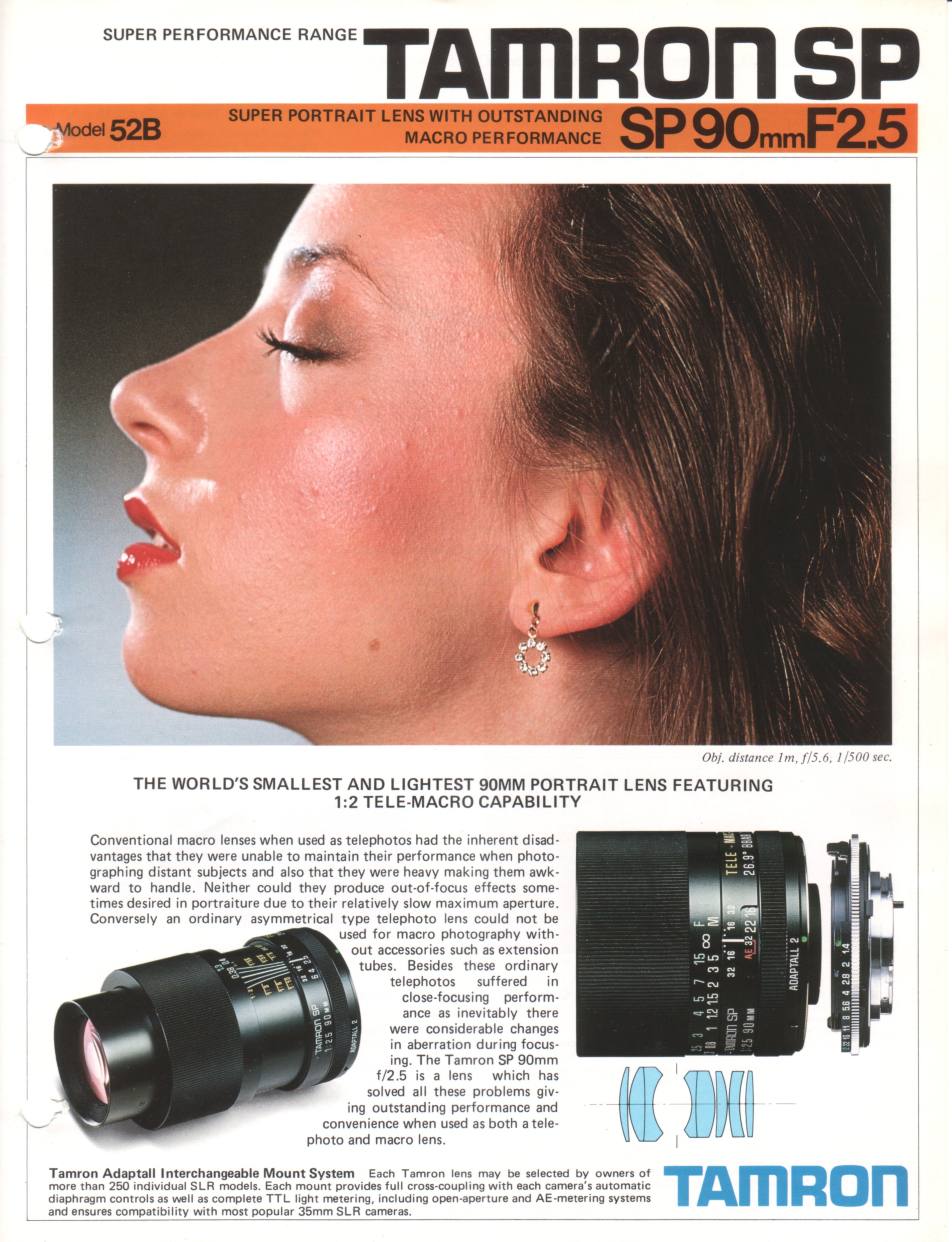
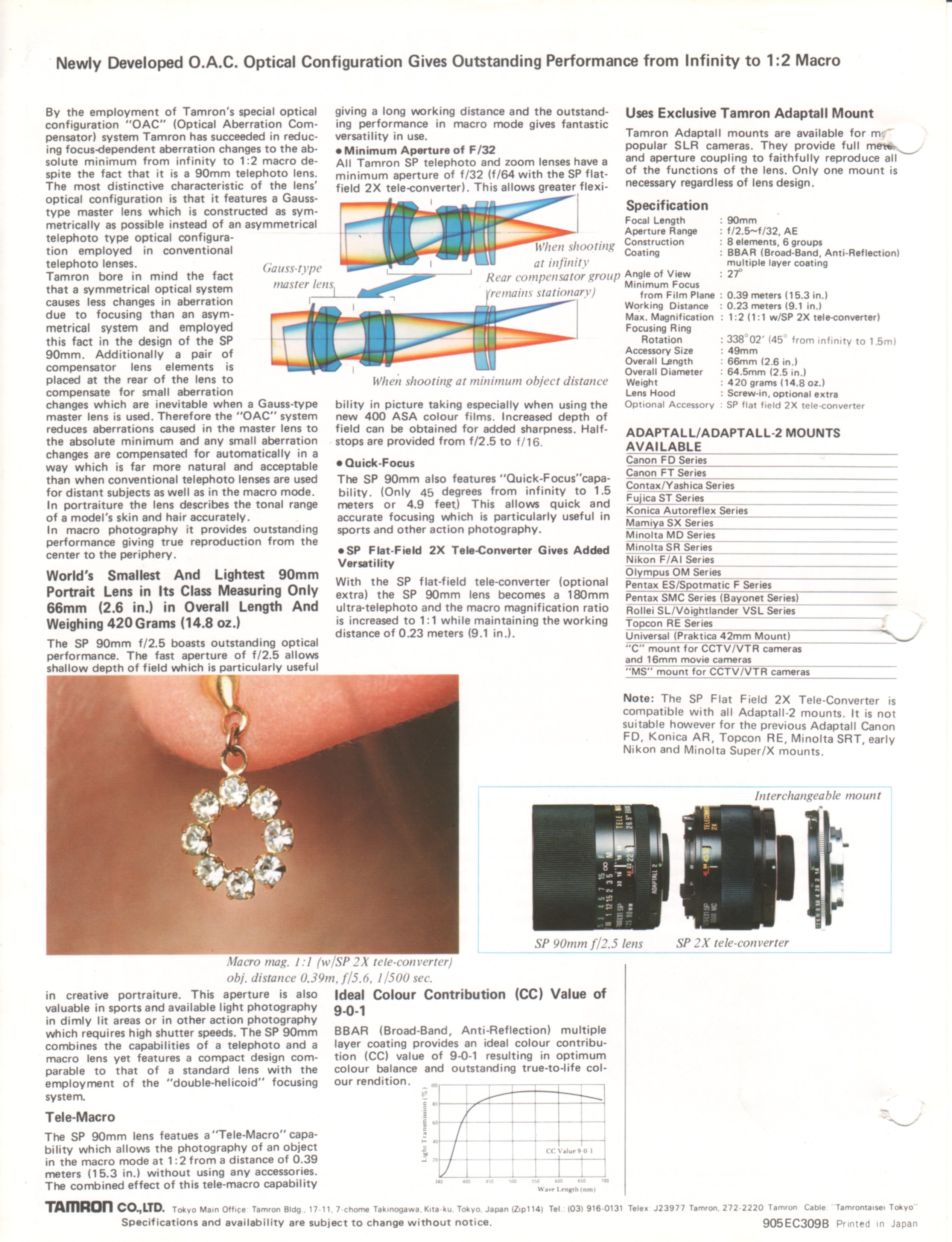
Tamron SP 52B 90mm f/2.5 () [; $97 in 2012]
A cult classic portrait/macro, it's a "best" because of its unique design;
can suffer sensor reflections,
but always gives great bokeh and intense sharpness stopped down;
brochure page
1 and
2
Tamron SP 90mm 1:1 Macro f/2.8 () [$650 in 2017]
What can I say? This is a virtually perfect lens. It isn't small, especially with its hood,
and it does live in a plastic shell (but has focus limiter, image stabilization, etc.).
In sum, it is what the above manual lens evolved into
Rodagon XR Heligon 95mm ~f/1.3 (converted to )
See Instructable;
somewhat longer rear-focus, but still very special-purpose
(H50,H51)
Vivitar Macro 100mm f/3.5
(manual focus version of the "plastic fantastic") () [; $35 in 2010]
It's a 100mm macro, but sharpness isn't quite what one hopes to see from a true macro;
matched front-mounted 1:1 adapter works surprisingly well
Canon FDn 100mm f/4 Macro () [; $40 in 2013]
Great macro, as reliably good as the 50mm Rokkor;
heavy -- which may have something to do with the mangled mount flange
that I had to replace
(H48,H49)
Minolta MD Macro Rokkor-X 100mm f/4 () [; $100 in 2013]
Great macro, as reliably good as the 50mm Rokkor;
easily best of my 100mm macros (beating the FDn), so I've given it the title
SMC Macro Takumar 100mm f/4 () [; $100 in 2010]
Great macro, but touchier than others; just ok at longer focal distances
UV Topcor 100mm f/4 () [; $6 in 2020]
Very attractive little lens; good bokeh, but low contrast
Sony FE STF GM OSS 100mm f/2.8 (T/5.6) () [$1498 in 2017]
The latest implementation of Smooth Trans Focus technology;
very sharp with the smoothest bokeh of any lens and autofocus and optical steady shot
Wollensak Raptar 101mm f/4.5 (on lensboard in Rapax shutter) [; $50 in 2012]
Covers 4x5 with very soft corners; a Tessar design?
Sharp in the center by f/5.6, but field gets better until f/22.
Kodak Ektar 127mm f/4.7 (on lensboard in Supermatic shutter) [$? in 1948]
A common, coated, lens that just covers 4x5 press cameras;
excellent resolution with low contrast, optimal around f/11-16;
scanned literature
overview,
DOF table, and
flange dimensions.
Spiratone 135mm f/1.8 () [$135 in 1973; $150 in 2010]
Real fast with exceptionally smooth transition to
out-of-focus, which means magnified view is needed for focus;
on FF, very sharp even wide open with modest contrast, but
things very OOF are a bit nervous
Super Takumar 135mm f/2.5 () [$94 in 1971; $72 in 2009]
Good all-around fast 135mm, but not small nor light; still better on FF,
with excellent bokeh, but before focus point looks even better than after,
and there is some red fringing around bright white stuff
Elicar 135 f/2.8 ()
Very sharp and versatile with close focus; great IQ stopped down, but lots of PF wide open
Auto Mamiya/Sekor 135mm f/2.8 () [; $8 in 2009]
This lens has the aperture ring extend back over the M42 flange, so it requires a
special M42 adapter; IQ is hurt by very low contrast, but sharpness and bokeh are good
(H51,H49)
Minolta MD Tele Rokkor-X 135mm f/2.8 () [; $15 in 2014]
build is excellent but largely plastic;
unfortunately, a rubbery black paint was applied to absorb reflections and
it seems to absorb fungus even better -- the majority of old Minoltas with
this paint are infected, and the rear element of this was covered
with a few spots deeper in...
after I cleaned it
(here's how
to open it), spots are gone but rear element still looks funny...
and yes, the IQ is that good despite the fungus damage!
On FF, it's awesome; on APS-C, bokeh are not quite as smooth, but still
quite good. There is some PF and bokeh CA, but no worse than the f/3.5 version.
Incidentally, the various f/2.8 versions are discussed
here.
Sears 135mm f/2.8 Auto Multicoated () [; $8 in 2009]
not radioactive #178?
Soligor 135mm f/2.8 Telephoto () [$117 in 1977?; $10 in 2009]
Wide open good color and very flattering glowy sharpness; stopped down, IQ is horrific (internal reflections?);
on full frame, wide open seems very soft and stopping down just gives a big hot spot
not radioactive #28100???
Vivitar 135mm f/2.8 Auto Telephoto (, , , ) [$124 in 1975; $15 in 2009]
Very servicable overall, good close up or even on bellows;
APS-C IQ was "A-" on 14MP, but now I'll call it "B+"
(H49,H48)
Canon FD 135mm f/3.5 (, ) [$185 in 1986; $10 in 2012]
Really quite good on FF (see this);
colors look good and bokeh doesn't really show a bright outline
not radioactive #7618???
RE Auto-Topcor 135mm f/3.5 ( ) [; $50 in 2020]
This was very professionally converted to M42 mount;
very clean images with no PF, perhaps my best 135mm,
but for now I'll call it a tie... it probably beats
my MD Rokkor-X f/2.8, but probably not a fully clean one
Konica Hexanon 135mm f/3.5 () [; $8 in 2014]
Not the best anything, but quite appealing rendering on the A7
Minolta MC Tele Rokkor QD 135mm f/3.5 () [$137 in 1976]
The aperture sticks in mine, so I hadn't tested enough to appreciate IQ; it's actually great except for bokeh-CA
(H51,H49)
Minolta MD 135mm f/3.5 () [; $10 in 2016]
A very appealing little lens with a built-in shade.
IQ seems excellent.
Super Takumar 135mm f/3.5 () [$58 in 1971; $40 in 2009]
Supposed to have and does have really good IQ, but not awesome
Jupiter 11 135mm f/4 () [; $10 in 2012]
See Instructable on Kiev 10/15 mount;
people say the 11 isn't great, but IQ on this one is very good (and very Soviet)
Rodenstock Rogonar-S 135mm f/4.5 (on lensboard, on lensboard) [; $10,$13 in 2012]
Only ok as a taking lens, designed for an enlarger; covers 4x5
Wollensak 135mm f/4.5 Enlarging Raptar []
This says it covers 4x5" and is in a #3 iris barrel;
Tessar with 4 elements in 3 groups
Rodenstock Omegaron 150mm f/4.5 (x0.75mm pitch) [; $10 in 2012]
Really an excellent taking lens;
4 elements in 3 groups; officially covers 4x5"
Wollensak 162mm f/4.5 Enlarging Raptar [; $30 in 2022]
This says it covers 4x5" and is in a #4 iris barrel;
Tessar with 4 elements in 3 groups
Golf Montauk approx. 6" (152mm) f/8 Junior/Wollensak (on lensboard) [$18 circa 1901?]
Low contrast; needs f/32 to evenly resolve perhaps 30 lpm -- covers 4x5, but not compelling on APS-C
Minolta MC Tele Rokkor-X 200mm f/3.5 () [; $29 in 2017]
Not small, feels very much like big brother to the 58mm f/1.2;
perhaps not quite as sharp as the f/4 version?
Vivitar 200mm f/3.5 Auto Telephoto (, , ) [$169 in 1976; $20 in 2009]
Good IQ, but the poster child for bokeh-CA... either use B&W or beware bokeh-CA when composing shots;
poorer resolution than my other 200mm lenses
Minolta MD Tele Rokkor-X 200mm f/4 () [$200 in 1981; $34 in 2015]
Small and light for a 200mm; quite crisp overall, bokeh-CA is reasonably well controlled
UV Topcor 200mm f/4 (, ) [; $6 in 2020]
Reasonably small and light with a nice built-in hood (which it needs);
long close focus distance makes it annoying;
probably the only UV lens that outperforms the closest RE equivalent
Minolta F. Rokkor-QF f/5.6 (barrel) []
Heavy barrel lens, marked as 199.95mm;
covers around 250mm diameter
Rodenstock Omegaron 210mm f/4.5 (special mount) [; $14.50 in 2022]
Here's my mounting solution;
4 elements in 3 groups; officially covers 4x7"
NuArc Process Lens 8 1/4" (210mm) f/8 (on lensboard) [; $12 in 2012]
Beautiful construction and probably covers 8x10;
better stopped down a little,
but contrast is low
S-M-C Takumar 300mm f/4 () [$200 in 1971; $185 in 2009]
Very good IQ after easily fixing CA, but slow to handle and rather long close focus;
it feels very professional, but is awkward and IQ isn't that great
Spiratone Minitel-S Plura-Coat 300mm f/5.6 () [; $150 in 2011]
Very appealing little mirror lens, but not particularly sharp
Tele-Astranar 400mm f/6.3 () [$76 in 1980; $15 in 2010]
Something like 6-9 pixels of CA and color shift on stopping down... probably ok for B&W
Soligor 400mm f/6.3 () [$180 in 1972; $15 in 2010]
Technically not good because of CA, but very highly usable
C. P. Goerz Apochromat • Artar 19in f/11 (lensboard) [$? in 1954?]
Coated (red dot) true apo lens optimized for color process work;
excellent resolution covering 19" circle, optimal around f/22;
scanned literature
overview and
pricelist.
Spiratone Mirror-Ultratel 500mm f/4 () [; $371 in 2025]
Clearly a professional-grade 500mm, but huge and heavy;
unbeatable if you love donuts;
discussed here as first half of 1970s lens bundled with
a teleconverter
RE Auto-Topcor 500mm f/5.6 () [$887 in 1969; $58 in 2022]
Topcon's longest professional lens, only 360 were built;
huge and heavy, but with excellent image quality except for bokeh CA
Bower (Samyang) 500mm f/6.3 DX () [$180 in 2009]
May be as good as a 500mm mirror gets; adding tubes gives great close focus without sacrificing infinity
Minolta AF Reflex 500mm f/8 () [; $170 in 2020]
Really an excellent mirror lens, but better because it can autofocus on an LA-EA4
and most mirror lenses look soft because of focus errors this doesn't make;
I suspect the Samyang 500mm f/6.3 mirror is as good, but it's nearly impossible
to manually focus it well enough to match this Minolta
Kimunor 500mm f/8 ()
Pretty light and well corrected as long lenses go, decent IQ (good for a 500mm); can be hand held
Meade DSX-90 Multi-Coated Maksutov-Cassegrain 1250mm f/13.8 (telescope eyepiece mount)
It's a reasonably serious telescope, complete with computer-controlled mount;
actually hand-holdable, very sharp, and focus knob works easily with great precision,
but vignettes on FF.
For similar reasons to wide angle lenses, old zooms are largely bad news. However, the consumer preference for zooms has really made the image quality of zooms much closer to that of fixed-focal-length lenses than one would expect. From the old Vivitar Series 1 zooms on, it was more a matter of cost and weight being higher than of image quality being much lower. However, image quality at the long end of many zooms is markedly inferior to what you get at the short end. Many zooms also have significant changes in the secondary image characteristics (e.g., large-scale contrast and bokeh) as one zooms.
Sigma 8-16mm f/4.5-5.6 DC HSM () [$675 in 2012]
So wide that it's hard to use, but what a great lens!
If only the autofocus worked with LA-EA1/2 on my NEX-7...;
it covers FF at 16MM with really excellent IQ, but not at much shorter focal lengths and it also vignettes on FF
using the 1.5X teleconverter trick
Venus Laowa 10-18mm f/4.5-5.6 FE Zoom () [$850 in 2019]
This is small, the widest FF zoom lens, and can focus close;
IQ isn't perfect, but is competitive with other ultrawides and gives nice sunstars;
focus scale seems off to allow infinity without the rear-mounted filter
Sigma 10-20mm f/4-5.6 EX DC () [$450 in 2009?]
Not sharp until f/7, but originally standard for APS-C ultra-wides (was a best, now demoted to A for APS-C);
focus broke on mine;
the FF performance is using a 1.5X teleconverter, where it covers FF nicely and well
with IQ that is honestly a touch better than on APS-C
Sigma 12-24mm f/4.5-5.6 EX Aspherical DG () [$829 in 2004; $275 in 2017]
Older FF brother to APS-C 8-16mm; nicer, but optically not quite as good
(weaker in the far corners); still a very versatile ultrawide workhorse
Sony E OSS 16-50mm f/3.5-5.6 ()
Controversial tiny kit zoom; IQ is as good as other Sony/Minolta kit zooms,
but at wide angle it relies heavily on distortion correction;
never covers FF, although it almost does around 24mm
Quantaray 18-35mm f/3.5-4.5 () [? in 1994; $32 in 2017]
A cheap, plasticy, full-frame ultrawide that resolves well at low contrast;
same as Sigma 18-35mm F3.5-4.5 Aspherical UC
Sony E OSS 18-55mm f/3.5-5.6 (, )
Really a great kit zoom, this deserves more respect than it gets; distortion at wide is significant, but NEX can fix it
Sony AF DT 18-70mm f/3.5-5.6 SAL-1870 (, ) [$200 in 2006 (near free with body)]
Really a great APS-C kit zoom,
harmed mostly by fixable CA that makes it look unsharp at the edges;
surprisingly usable as a FF 24-70mm
@24(H41,H43) @40(H56,H54)
Sun Wide Zoom Macro 24-40mm f/3.5 ()
Another deservedly famous lens, if not compelling against a modern kit zoom
Telephoto converters, which mount behind the lens and increase the
effective focal length by magnifying the image, are very convenient.
For example, throwing a little converter in your bag can essentially
double the number of lenses you're carrying. Another neat feature is
that it is not too difficult to use a teleconverter to adapt a lens
in one mount to a camera with another; such "glass adapters" can be
made to allow infinity focus even for lenses that have a much shorter
back focus than the camera body's mounting flange distance. However,
there are issues with using any type of teleconverter.
Teleconverters multiply the focal length without changing the physical aperture,
so the images get darker: a typical "glass adapter" is around 1.2X and costs
about 1/2 stop, 1.4X costs 1 stop, 2X costs 2 stops, and 3X
costs approximately 3 stops. For example, a 50mm f/1.4 with
a 2X converter becomes a 100mm f/2.8. Further, magnifying
the image is amplifying the defects, so problems like color fringing
are correspondingly more severe using a teleconverter. Traditional wisdom is
that teleconverters should only be used with normal or longer focal lengths,
but I think the issue is really that shorter lenses have more elements, and
teleconverters are adding to that count -- aberrations, transmission, etc.
all are hurt by having so many elements. In other words, teleconverters on
zoom lenses might not be the best idea either. Finally, teleconverters seem
to cause significant glow when used with fast lenses near wide open; this is
probably a reflection issue, and might involve a reflection of the imaging
sensor (making the effect body dependent). The good news about the glow is
that sometimes it is an artistically desirable effect, and teleconverters
often seem to also soften the edges of the PSF of most lenses, yielding
smoother bokeh.
A focal reducer is the logical inverse of a teleconverter. They
only work where the lens coverage is larger than the intended
sensor and there is space for the reducer to get closer to the
sensor -- i.e., mirrorless cameras with smaller-than-FF sensors
or FF cameras with larger-format lenses. Reducers brighten the
image because the aperture doesn't shrink as the focal length
does. Aside from the usual badness from having more glass, the
big issue with reducers is that they make off-axis image defects
of the base lens much more evident.
There are a wide variety of glassless lens mounting devices intended to either
provide closer focus (greater magnification) or the allow use of lenses with a
mount different from that on the camera body. None of these should have a
dramatic impact on image quality, although lenses often are not as sharp nor
well-corrected at higher-than-intended magnifications. Bellows are incredibly
versatile for macro photography -- especially the Spiratone below, which has
rapid coarse adjustment of length by simply pressing in on the focus knobs --
but all bellows change air volume dramatically as you focus and thus are dust
infusers. Tubes are less flexible, but often cheaper and more convenient. I
had hoped that the cheap tubes that use screw threads for the extension parts
would use the same thread for different mounts, thus also being macro adapters
between different mounts, but the tube diameter changes with the mount.
Automatic extension tubes provide coupling between the body and lens -- which
very few bellows do -- but the coupling doesn't do anything when the tubes are
mounted on a digital camera using a mount adapter.
It is worth noting that some of the adapters have quirks. For example, I don't
know why, but adapters for
The
Given that none of these adapters has any glass, rating the optical quality
would be pointless... build quality ratings here are
This section doesn't really belong here, but I don't want to make another page
for these bodies that can mount the above lenses... most of which I don't use.
In particular, I really don't see much point in shooting film anymore. Anyway,
most of the following came with lenses I wanted....
It is worth noting a couple of things about this list.
First, although I used Canon
DSLRs for years, the lack of electronic controls on DSLRs compared to
compacts made me prefer compacts. They were simply more versatile for
the tethered shooting that was my primary application.
For personal use, APS-C DSLRs were particularly discouraging because
I like wide angles, and there pretty much were none for APS-C.
It was the release of the Sigma 10-20mm that made DSLRs worthwhile
for me personally, and the Sony A100 seemed to be the highest-quality
sensor one could put behind it at that time.
I also always liked Minolta handling,
and the A100 was very Minolta. I have not purchased a non-Sony DSLR
since then, and I'm now more centered on mirrorless digital bodies.
A NEX-7 is clearly in my future.
Second, I collected most of the film cameras below because I wanted
the lenses they were bundled with on eBay -- which explains the heavy
bias toward M42 mounts and certain brands. However, there's also a
clear trend here. I have not a single bad Kiev, Pentax, Mamiya/Sekor,
Zenit, or Sony body.
Of 11 Minolta bodies, only one doesn't work (the mirror is stuck up,
which might actually be a very minor issue). Of 5 Canons, two have
problems: one has the eyepiece glass loose and the other is completely
inoperative. The only Petri looks beautiful, but is completely dead with
a shutter problem. Read what you will into all that.
Since I have so many lenses, I have noticed a number of trends.
Here's the quick summary....
I have a variety of other links relative to my work in
digital imaging, computational photography, etc.,
at http://aggregate.org/DIT/.
That includes various things about use of old lenses with
modern digital cameras and sensors.
MC AUTO ZOOM CPC PHASE 2 CCT CPC 28-50mm MACRO f/3.5-4.5 () [; $10 in 2019]
Really Pentax?
Good flare resistance and nice in the center,
but smeary at FF edges with distortion and vignetting
(really odd labeling on this lens)
Soligor C/D Zoom+Macro 28-55mm f/3.3-4.5 () [; $5 in 2011]
The problem with this lens is low contrast;
bokeh are exceptionally good for a zoom, especially in macro;
it's really a "B+" lens, but the lower resolution demand by FF
is why the "B"/"A" rating
Sigma 28-70mm f/3.5-4.5 ()
Deitz 28-80mm f/3.8-f/4.8 ()
Unexciting range and aperture with 1:4 "macro"; nice build and IQ is a tad better than average
Tokina 28-85mm f/4 ()
Tamron 28-200mm f/2.8-5.6 Di III RXD Model A071
() [$688 in 2022]
A really excellent one-lens-to-do-it-all choice, pitty it doesn't start at 24mm;
the bests here are against similar zooms
Sigma 28-200mm f/3.5-f/5.6 Macro D Aspherical IF ()
I did not expect decent IQ, but aside from colors this does quite well; autofocuses fast on my A55 too;
my favorite "just grab a lens" choice for FF
Vivitar 28-210mm f/3.5-f/5.6 Auto Focus Zoom ()
Sadly, IQ is what you'd expect from a cheap superzoom and close focus is very long;
however, bokeh are better than you'd expect and it's not bad at f/11
@35(H44,H44) @70(M57,H50)
Minolta MD Zoom 35-70mm f/3.5 () [$260 in late 1980s; $25 in 2017]
Well made with some plastic, this 2nd version doesn't focus close;
reputation of bettering primes, but doesn't before f/8
@35(H44,H47) @70(M60,H46)
Canon FD 35-70mm f/3.5-4.5 () [$170 in 1986]
Perhaps the most plastic-feeling build, although it seems mechanically and optically ok
on APS-C; FF corners are miserable
Minolta AF 35-70mm f/4 (baby beercan) () [$175 in 1985; $22 in 2010]
Beercan-like good IQ, but not a very useful zoom range and mine has a sticking aperture
Minolta AF 35-80mm f/4-f/5.6 II (silver) () [; $10 in 2011]
I'm starting to think Minolta never made a truly bad kit lens (unlike Canon); looks ugly as sin, works really well
Minolta AF 35-105mm f/3.5-f/4.5 N () [; $25 in 2017]
Tiny lens for its range, IQ great by f/8, but too soft wide open for even 16MP APS-C;
Minolta colors, better than average bokeh for a zoom, and fast AF make it a good FF walk-around lens
Sony AF DT 55-200mm f/4-5.6 SAL-55200 () [$230]
Really not a bad lens, but I nearly always use the beercan or 75-300mm instead
Tamron SP 60-300mm f/3.8-f/5.4 23A () [$300 in 1986; $50 in 2012]
Big, heavy, optically quite good... but can't get into macro mode?
Rokunar 60-150mm Macro f/4 () [$276 in 1968]
Vivitar Series 1 Q-DOS 70-210mm f/2.8-4.0 (Cosina; 5th version) () [; $290 in 2011]
This is the rare 3D capture version... which has horrific IQ in 3D mode ,
outstandingly good IQ otherwise
not radioactive #22309???
Vivitar Series 1 70-210mm f/3.5 (Kiron; 1st version) (, , ) [$340 in 1977; $33 in 2010]
A cult classic; the one-touch zoom/focus actually works very well and IQ is good, but the lens is big and heavy;
the full-frame A is really when using it for close up work
Kiron (Kino Precision) 70-210mm f/4 macro 1:4 () [$359 in 1984; $10 in 2016]
Very similar to the Vivitar Series I zooms, but better built!
There's vignetting on FF, but it is sharp enough wide open and
bokeh is exceptionally good (especially for a zoom lens).
Here is a mini-review of it when it was new, which explains the zoom
lock and min/max focus stops... which are part of why I say this is my
best built lens, along with the fact that it's very smooth and you could
smash rocks with its heavy metal body.
Minolta AF 70-210mm f/4 (beercan) () [$263 in 1985; $160 in 2010]
Not awesome and rather big and heavy, but a very respectable constant f/4 zoom with good color
Olympus Zukio Auto-Zoom 75-150mm f/4 () [; $20 in 2017]
Quite small despite having a built-in hood;
aberrations make for soft wide open performance, but it's punchy stopped down
?
Vivitar AF 75-200mm f/4.5 Auto Focus Zoom () [$250 in 1987; $25 in 2017]
Lens AF is driven by three AAA cells, fairly fast and quiet; mostly plastic construction, but well made;
reviewed by Popular Photography in 1988
Vivitar 75-205mm f/3.8 Close Focusing Auto Zoom ()
Not a bad lens, but soft and has field curvature; close focus is better
than distance shots
Minolta AF 75-300mm f/4.5-5.6 D () [$150 in 2005]
I use this lens a lot; it's not perfect, but is small and gives solid IQ for a 75-300mm
Sigma Zoom Lambda II 75-300mm f/4.5-5.6 () [; $8 in 2014]
A shockingly good manual zoom! Peaks like crazy even wide open and gives that 3D "pop,"
nice bokeh, etc. Can actually keep up with the NEX-7 sensor, with just a little glow wide open.
Very smooth operation, but does suffer zoom creep.
Soligor C/D Zoom+Macro 80-200mm f/4.5 () [; $10 in 2011]
Better IQ than the Vivitar Series 1 and smaller, but slower too
Promaster 85-210mm f/4.5 () [$180 in 1978]
IQ is OK, but loose build feels like it will fall into pieces at any moment; awkward separate focus and zoom rings
Minolta MD Zoom Rokkor-X 100-200mm f/5.6 () [$225 in 1981; $18 in 2015]
Long and slow, but light and silky smooth one-touch zoom+focus; excellent IQ from wide open
Vivitar 100-300mm f/5 () [; $23 in 2014]
A likable lens with good close focus;
very good big & heavy build, good contrast even at 300mm, OK resolution;
veiling flare and bad PF; my mini-review on DPReview
Canon FDn 100-300mm f/5.6 () [; $10 in 2012]
Sharp with good color, but PF and glow around 300mm and it's huge
Phoenix 100-400mm f/4.5-6.7 () [; $67 in 2017]
Low contrast and modest resolution, but better than cheap 400mm f/6.3 lenses;
doesn't vignette, has good bokeh, but doesn't focus very close;
silver-painted plastic
Tamron 150-500mm f/5-6.7 Di III VC VXD Model A057
() [$1271 in 2022]
A designed-from-scratch-for-FE lens that really sets a new standard;
resolution charts are near perfect and real performance is excellent
Tele Converters (and "glass adapters") and Focal Reducers
Zhongyi Lens Turbo Focal Reducer (via eBay roxsen; 0.726x reduction) ( lens to body) [$188 in 2013]
Works very well, but sensor reflection and flare can be issues,
too-long aperture pin/tab on lens needs to be shaved;
works perfectly (even good rotational alignment -- lenses sit
top side up!) with M42 adapter
Metabones Speed Booster (0.71x reduction) (Canon EF lens to body) [$599 in 2013 (owned by UK Visualization Center)]
The reference focal reducer; allows full control of EF lenses,
manual M42 lenses using a chipped adapter
Spiratone ~1.22X ( lens to body) [; $12.50 in 2010]
Vivitar macro focusing 2X ()
Great concept; makes a fast 50 into a 100mm macro that's decent stopped down a bit
Tamron Flat-Field SP 2X Tele-Converter 01F () [; $25.40 in 2012]
Supposedly an exceptionally good 6-element converter that also prevents sensor
reflections, but it has the usual IQ issues; brochure page
1 and
2
Vivitar 2X-4 (, )
Glassless Bellows, Tubes, and Adapters
and lenses to are often loose unless an
undocumented adjustment is made by using the tip of a screwdriver inserted in
a thin slot on the edge of the internal bayonette to slightly widen the
flange. Similarly, adapters for and lenses often have mounted lenses stop at random
rotational positions; there are some variants that allow the rotational stop
to be adjusted. Some of those adapters also have a ledge to depress the rear
stop-down pin, which makes lenses behave like
manual lenses, but can interfere with some lens back ends. Like I said, some
adapters are quirky.
lens mount is particularly problematic.
These Kiev lenses are relatively tiny but are fully self-contained with all
optical elements, focus helicoid, and aperture iris. Unfortunately, the
aperture control is completely inside the mount, which makes adapting hard.
There has never been much call for adapters, because this unnamed mount was
only used on the Kiev-10 and Kiev-15 cameras which were not intended for
export out of the USSR. I got such a good deal on a set of five lenses in this
mount that I built my own adapter.
if there is any play or optically-visible imprecision (the worst
case being lack of infinity focus on an adapter advertised as allowing it),
for a basic but solid device, and for units with exceptionally nice build and features.
Tamron Adapter ( lens to body) [; $10.25 in 2012]
Includes stop-down pin and gearing to reverse aperture coupling direction
Tamron Adapter ( lens to body)
Straightforward, well made
Tamron Adapter ( lens to body)
Straightforward, well made
Generic (Da Cheng) Adapter ( lens to body) [$14.50 in 2012]
Apparently a single piece of metal, no chip
Generic Adapter ( lens to body)
Actually, I have several and they're all T2 (rotate with set screw)
Generic Adapter ( lens to body)
Also T2 (rotate with set screw)
Fotasy (eBay rainbowimaging) Tilt Adapter (Canon EF/EFS lens to body) [$79.99 in 2011]
Effective, but somewhat rough to adjust; I use it with M42 lenses
Generic (eBay) Adapter ( lens to body)
Homemade adapter (no aperture control) using Kiev flange in a drilled body cap ( lens to body)
See Instructable;
awkward lack of aperture control, but otherwise nice
Homemade adapter with aperture control using Kiev flange on modified Canon FD Adapter ( lens to body)
See Instructable;
works really well
Generic (eBay) Adapter ( lens to body)
Generic (eBay) Adapter ( lens to body)
Generic (eBay) Chipped 50mm Adapter ( lens to body)
Generic (eBay) Chipped 100mm Adapter ( lens to body)
Generic (eBay) Chipped 500mm Adapter ( lens to body)
Generic (eBay) Adapter ( lens to body)
FOTGA (eBay emilyandlily) Adapter ( lens to body) [$7.27 in 2012]
Generic (eBay) Adapter ( lens to body)
Petri Adapter ( lens to Petri bayonette body)
Generic (eBay) Adapter ( lens to body)
FOTGA (eBay emilyandlily) Adapter ( lens to body) [$11.30 in 2012]
Generic (eBay rainbowimaging) Adapter (Nikon lens to Canon EOS body)
Sony LA-EA1 Adapter ( lens to body)
Great adapter with body control of aperture and painfully slow autofocus on A-mount lenses with motors built-in
Sony LA-EA2 Adapter ( lens to body) [$306 in 2012]
An LA-EA1 + SLT mirror + screw drive; focus speed very comparable to A55 with A-mount lenses
Generic (eBay adplo) Macro Extension Tube Set () [$6.90 in 2010]
Generic (eBay adplo) Macro Extension Tube Set () [$7.99 in 2010]
Generic (eBay henry-digital) Macro Extension Tube Set () [$5.98 in 2010]
Generic (eBay rainbowimaging) Macro Extension Tube Set () [$10.99 in 2011]
Vivitar Automatic Extension Tube Set ()
Vivitar Automatic Extension Tube Set () [; $22.32 in 2011]
Minolta Bellows III () [$12 in 2012 (new old stock)]
What a deal on the price! Very smooth and solid bellows
Spiratone "Rapid Rail" Macrobel (Pentax K, )
Feels a tad flimsy, but very fast to use and effective... very Spiratone ;)
Camera Bodies
Canon FTb (two working) [1971]
Canon TLb (one not working) [1974]
Canon AE-1 (one with broken viewfinder) [1976]
Canon T70 (one working) [1984]
Kiev 15 (one working) [1978]
Mamiya/Sekor 1000 TL (one working) [1966]
Mamiya/Sekor 1000 DTL (one working) [1968]
Minolta SRT101 (mine from the 1970s, another via eBay) [1966]
Minolta XK (mine from new and still great) [1973]
Minolta X370 (one working) [1974?]
Minolta X7a (one working with motor, another not working) [1974?]
Minolta XE5 (one with broken self-timer) [1975]
Minolta Maxxum 3000i (one working) [1989]
Minolta Maxxum 5000i (one working) [1989]
Minolta Maxxum 7 (one working and still great) [2000]
Minolta Maxxum 70 (one working) [2004]
Pentax Spotmatic (my dad's from new) [1964]
Pentax Spotmatic SP II (one working) [1971]
Pentax ES (one working) [1971]
Pentax Spotmatic SP F (one working) [1973]
Petri MF-1 (one not working) [1977]
Sony A100 (mine from new) [2005]
Sony A350 (mine from new) [2008]
Sony A55 (mine from new) [2010]
Sony NEX-5 (mine from new) [2010]
Sony NEX-7 (mine from new) [2012]
Zenit 122 (one working) [1990]
Parting Comments (personal opinions only)
and Nikon non-ai mounts usually differ
significantly in price, and the more-adaptable is the cheaper one! I'll get lenses in these mount
iff the price is right, and that hasn't happened yet in two
years searching eBay.
For More Info
 The only thing set in stone is our name.