
H. G. Dietz
http://aggregate.org/hankd/
Department of Electrical and Computer Engineering
Center for Visualization & Virtual Environments
University of Kentucky, Lexington, KY 40506-0046
Initial release: September 26, 2009; last update: July 23, 2014
This document should be cited using something like the bibtex entry:
@techreport{oldlens20090926,
author={Henry Gordon Dietz},
title={{Old Film Camera Lenses On New Digital Cameras}},
month={Sept},
year={2009},
institution={University of Kentucky},
howpublished={Aggregate.Org online technical report},
URL={http://aggregate.org/DIT/OLDLENS/}
}
A well-maintained 40-year-old lens from a 135 SLR (Single Lens Reflex) camera can be just as good as it was new -- and may be an excellent lens for your new DSLR (Digital SLR). Or it might not even be usable. Your odds are significantly better using a mirrorless (with removable lens) body that has a short lens-mount flange distance, but that's not a sure thing either. Here's an overview of how to determine which old interchangeable lenses might be worth buying and using.
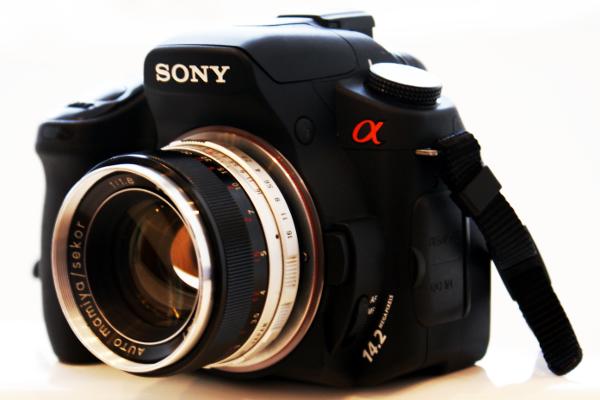
The photo above shows my Sony Alpha A350 with a Mamiya/Sekor 55mm f/1.8 lens mounted using a focus-confirm M42 adapter. The image quality of this lens was a pleasant surprise; it quickly became the lens I use most often... until I got more old lenses. If you are interested in being a bit more creative (destructive?) about how to combine a digital imaging system with an old lens, take a look at this use of an old 4x5 sheet film camera as a webcam. For more practical stuff, read on....
Different brands of DSLR generally use different types of lens mount -- modifying a lens with an incompatible mount to work on your DSLR probably is a lot more trouble than it's worth. Truly compatible lenses are your most usable alternative, but there is another possibility: use of an "alien" lens via an adapter. Mirrorless cameras that don't leave a big gap behind the lens mount where the mirror would have been can instead use that space for an adapter, so adapters for them are easier to make.
One would naturally think that sticking to lenses made for the same brand of camera as your DSLR would be safe, but that's not always true. For example, Canon FD lenses do not fit on Canon DSLRs, and neither Minolta MC/MD nor Konica mount lenses fit Konica/Minolta (or Sony Alpha) AF DSLRs. Most mirrorless bodies have new mounts that didn't exist before digital so, for example, don't expect your Olympus Pen digital to have the same lens mount as an original film-based Olympus Pen.
Even when older lenses mechanically fit, they often do not provide the full functionality of newer lenses. For example, auto-focus of older Nikon lenses was driven by a mechanical coupling to a motor in the camera body, whereas newer lenses use electrical contacts to control a motor in the lens itself. Some Nikon DSLRs, such as the D60, don't have a motor in the body, and therefore cannot auto-focus the older lenses. There are similar problems with some old third-party lenses for the Canon EF mount; because the third-party manufacturers had to reverse-engineer the Canon lens interface protocol, they didn't know about some aspects that Canon didn't use until later cameras.
The safest way to check which mounts are compatible within your camera's brand, and what features may be lost, is to carefully read the manual that came with your camera body. There also is a nice guide posted at http://www.photoimagenews.com/lens.htm that covers many of the specifics of which lens fits what. If you are trying to figure-out which mount a particular lens has, http://rick_oleson.tripod.com/index-99.html gives a nice photo guide. Don't assume that because some ebay seller bundles a lens with a camera that the lens actually fits on that camera unless the description or photos make it clear that it does fit.
Of course, the only sure way to know a lens will work on your camera is to try it. However, there are some (rare) combinations for which trying it will leave a lens jammed on your camera mount or will cause the mirror to slap into the rear element of the lens... so look for warnings on the WWW before you try mounting that suspect lens. For example, apparently compatible lenses that have the "Ricoh pin" can get stuck on Pentax bodies, and quite a few adapted wide-angle and normal lenses get hit by the mirror on full-frame Canon DSLRs when near infinity focus.
Adapters of various kinds are available to allow alien lenses to mount on modern digital camera bodies. For example, using this sort of thing you can mount an old Pentax Takumar M42 mount lens on your new Canon or Sony DSLR.
Some adapters have glass in them, some don't. There are two very different reasons why an adapter can have glass in it. One type uses the glass to increase the lens focal length so that the image focus plane can reach a sensor that is set too far back from the lens mount. We'll call these teleconverting adapters. The other type doesn't need the glass to allow the lens to focus properly, instead using the glass to decrease the lens focal length. We'll call these focal reducers.
If your lens was designed to have the film closer to it's backside than your digital body can allow, you will not be able to focus on things far away unless you use a teleconverting adapter. These adapters are often quite cheap, and are usually much thicker than glassless adapters in order to provide space for the glass elements. They rarely mention the fact that they are actually low-magnification teleconverters.
These low-magnification teleconvertering adapters slightly magnify and darken the image. Although they often are advertised as 1:1 converters, they are usually more like 1:1.2. In fact, the magnification isn't hard to compute: just measure the flange-to-flange thickness of the adapter. My MC/MD-to-AF adapter is about 8.5mm; adding the 44.5mm AF flange distance we get 53mm. The MC/MD flange distance is about 43.5mm. Assuming the adapter glass is simply multiplying the focal length, the magnification is thus about 53/43.5, or 1.22X. Thicker adapters or greater flange distance differences produce greater magnifications; for example, Canon FL/FD had a 42mm flange distance, which means a comparably thin FL/FD-to-AF adapter would yield about 1.26X. Note that the adapter magnification factor also changes the lens aperture ratio correspondingly: my 50mm f/1.7 with 1.22X converter is essentially a 61mm f/2.1.
I recommend avoiding buying lenses in any alien lens mount for which teleconverting adapters are needed, but if you've already got the lens and body.... For example, Nikon SLRs have always had a relatively large gap between the film and lens mount, and their DSLRs have the same gap to the sensor. Thus, you will need teleconverting glass in adapters for most types of alien lenses you might want to put on a Nikon DSLR. The glass is used to project the image back beyond where the lens originally did, so that you can get "infinity focus" on your DSLR. The reason I don't recommend buying lenses that need this is that most of these adapters fairly obviously degrade image quality.
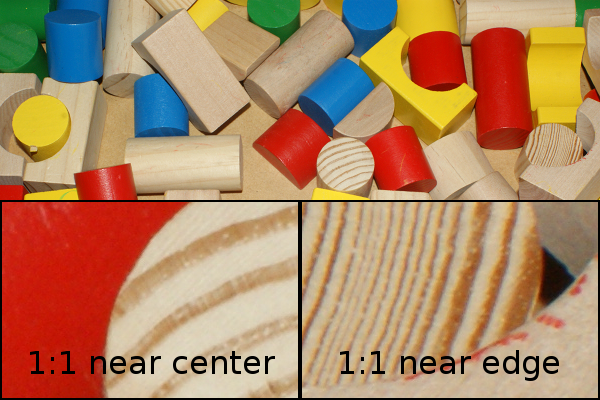
I have tested an old Spiratone glass Minolta MC/MD-to-AF converter adapting several MC Rokkors to a Sony A350. Image quality is surprisingly acceptable across the APS-C frame when stopped down. For example, the above photo was taken using an MC Rokkor 28mm f/2.5. On it's native mount, this lens makes outstanding images; in fact, glasslessly mounted on a Sony NEX-5 it is one of the sharpest lenses I've ever tried. Adapted to the A350 and stopped to around f/5.6, the image is acceptably sharp for a 14MP sensor, but has significant color fringes showing near the edge. In fact, this image looks a lot like what the Sony 18-70mm kit zoom delivers.

However, when using a fast lens wide open, the extra glass in the adapter seems to make very soft, low-contrast, images. The MC Rokkor 50mm f/1.7 is a slightly "glowy" lens by itself, but with the glass adapter the effect is very strong until about f/4 -- as the f/1.7 and f/4 shots of the Buck Rogers poster clearly show. The level of detail visible in both shots is nearly identical, but the f/1.7 glow qualifies for special effect use only (dreamy, yet sharp, portraits or landscapes). In fact, using an M42 SMC Takumar 50mm f/1.4 with a glassless M42-to-MC adapter combined with the glass MC/MD-to-AF adapter shows the same glow although this lens with a glassless M42-to-AF adapter does not evidence this defect. In general, the halation-like glow seems objectionable only for fast lenses near wide open. I used to think this was caused by reflections involving the low-magnification (flatish) glass of the adapter, but now I'm convinced it's nothing more magical than a heavy dose of spherical aberration (SA) from the adapter's poorly-corrected elements dramatically amplifying large-aperture SA of the base lens.
In other respects or with other types of lenses, the glass adapter seems to slightly amplify defects of the base lens, and I have found the impact on image quality to be relatively minor and often negligible. An interesting side note is that 2X and 3X teleconverters I have played with put comparable-quality glass in about the same position, but do not seem to produce the same glow. This is part of why I speculated that the flatter glass in the low-magnification teleconverting adapters caused more serious internal reflections (which I still believe it does), but I now believe the halation-like effect more likely comes from lower magnification converters having more marginal rays contributing to the image, hence showing more SA. Whatever the cause, the effect is clear.
Glassless versions of the teleconverting adapters that contain glass are available, but the glass was needed to make the lens image reach the extra distance to your sensor. Thus, those glassless adapters act much like a short extension tube, making your camera nearsighted. For such an adapter, how far away you can focus depends largely on the focal length of the lens. Telephoto lenses might still be able to focus on things reasonably far away, while wide-angle lenses might not get out of the macro range.
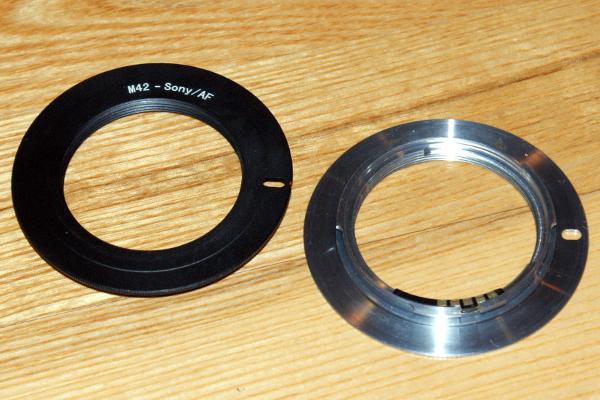
Fortunately, there are adapters for some pairings of alien lens and body mount that allow infinity focus without containing glass, and those are the ones that preserve the image quality of the lens. If you happen to have a 4/3, micro 4/3, Sony NEX E-mount, or Samsung NX, there is a pretty good chance there will be an infinity-focus glassless adapter for any alien lens with a popular mount. For most DSLRs, the "universal" M42 screw thread mount, which was used by old Pentax and Praktica cameras among others, is by far the most common alien lens mount that can be glasslessly adapted without losing infinity focus. M42 lenses adapt without glass to Canon, Sony, Pentax, and most other DSLR mounts... but not all -- for example, as I mentioned before, not Nikon. Although prices vary widely, you can expect an adapter to cost around $20 to $30. Some very nice looking adapters sell for as little as $5, but those are often slightly too thick to allow infinity focus (like the black adapter in the above photo).
As of 2012, a second type of glass adapter has come on the market: a focal reducer. The first one was called the Speed Booster, and it was quickly followed by the Lens Turbo and now the Light Cannon. Expect similarly modest names for these as more variations come out... so you're not likely to confuse these with the vaguely similar-looking teleconverting adapters.
Focal reducers are essentially the opposite of teleconverters. They rely on two properties of the lens and body:
In essence, the glass in the focal reducer simply divides the lens focal length without changing much else. That primarily widens the view angle. Of course, reducing the focal length without changing the diameter of the aperture also has the happy side effect of reducing the effective f/number in the same proportion. This apparent increase in lens speed is the basis for all those modest names....
Roughly speaking, APS-C is a 1.5X crop of a full-frame SLR lens image. Thus, a focal reducer shrinking the focal length by a multiplier of 0.67X or so would essentially restore the full-frame view angle. However, there are technical issues that make building focal reducers that get the full reduction difficult (or perhaps I should say image quality near the edges would be very bad?). Thus, the first round of focal reducers all have multipliers around 0.71X-0.72X. This results in an effective crop factor of approximately 1.1X -- which is about as close to full-frame as most SLR viewfinders or transparency slide mounts show. Within a comparably good approximation, 0.72X essentially doubles the light, meaning the effective f/number is reduced by one stop.
People seem to be very confused as to what a focal reducer really does, so let's take a simple example. My Canon FL 55mm f/1.2 can be glasslessly adapted to my APS-C sensor mirrorless Sony NEX-7. The catch is that I'm only capturing the central portion of the image, giving the view angle of an 83mm lens on a full-frame sensor. The depth of field (DoF) is still exactly that of a 55mm f/1.2, and the aperture is also still f/1.2. If I instead mount that lens using a Lens Turbo FD adapter (FL and FD are compatible), the lens is effectively changed into a 40mm f/0.95 -- so now the APS-C sensor gives me the same view angle I'd see using a 59mm lens on a full-frame sensor. The DoF of a 40mm f/0.9 is effectively somewhat greater than you had with the APS-C crop of the 55mm f/1.2 alone (essentially the same DoF as the 55mm f/1.2 would have had on a full-frame sensor with the same pixel count as our APS-C sensor). If you think about it, the extra lens speed exactly compensates for the smaller sensor area, so a full-frame sensor and APS-C sensor built using the same technology would have the APS-C ISO be half that of the full-frame sensor and the result would be identical exposure times... but APS-C sensors tend to have slightly better technology (because production yield is higher with a smaller sensor), so there really is an effective improvement of close to one stop using current bodies.
Too complex to think about? Just think of a 0.72X focal reducer as making your full-frame lens behave very much like it does on a full-frame camera despite your APS-C sensor. It also gets a little brighter.
What about image quality? Well, that's an interesting issue for a focal reducer.
A teleconverter can't improve image quality for all lenses it might be used with, but theoretically a reducer can concentrate rays such that resolution, chromatic aberration, etc. are all improved by approximately the reduction factor. In practice, a well-designed and implemented focal reducer will nearly always improve image quality near the center. However, the center improvement might be invisible if the base lens was already good enough to match the sensor resolution. Edges may get better or worse. The primary reason for edge issues with a well-designed reducer is the fact that full-frame lenses are not as well corrected near the edges, and the artifacts can interact badly with the optics of the focal reducer. Of course, no focal reducer is perfect, so they also will add somewhat to the list of image quality problems.
In fact, a focal reducer could do just as much bad as a teleconverter -- adding glow, flare, etc. It looks like the Speed Booster gives the best image quality, which makes sense given the track record of its designers and the development effort invested in it. In fact, here is a nice little white paper they wrote explaining what they did. The Lens Turbo seems to be surprisingly good given its lower price and short time to market, but it does flare more and often produces a bluish spot in the center of strongly lit scenes. It seems that the Light Cannon was a little too rushed to market (terrible image quality and, in fact, the "Light Cannon" name was already in use as a brandname for an underwater movie light), but the manufacturer has already acknowledged the terrible image quality and promised free replacement with an improved version II. The Light Cannon is also to be released in a 0.5X version giving a two-stop advantage for use of full-frame lenses on micro 4/3 sensors... but that's a very aggressive thing to promise when your 0.72X reducers have so much trouble.
Personally, I think focal reducers are very useful and actually make an APS-C sensor more versatile than a full-frame one. Why? Basically, you get a choice between full resolution APS-C "sweet spot" crop of the center of the lens image or the full resolution full-frame view. Actual full-frame sensors can't give a full resolution APS-C crop. In fact, to match my 24MP APS-C NEX-7, you would need a full-frame sensor with 54MP -- which nobody is offering (yet).
Some adapters preserve more functions than others. Consider the two M42 to Sony Alpha adapters in the above photo. Simple adapters, like the black one, usually disable most features because the camera body literally does not even know there is a lens attached. In contrast, "chipped" or "focus confirm" adapters, like the chrome one, contain a processor that communicates with your DSLR body to tell it some information about the lens attached.
With a chipped adapter, it is common that the DSLR's auto-focus system can give you an indication of when you have focused properly (although it cannot focus for you). Different cameras indicate when focus is achieved in various ways: an indicator light, focus point display, or an audio signal. Focus aids are more important than you might expect, because, especially with very fast lenses, it is easy for things to look sharp in the finder but be slightly off. Focus with f/1.4 and faster lenses is particularly touchy.
Another help in focusing is a smart camera trick called trap focus. In trap focus, the idea is simply that the camera is pointed and focused at a position your subject is expected to pass through, and the camera will automatically delay triggering the shutter until the focus sensor says something is now in focus. It was originally intended for things like capturing photos of the bride and groom as they walk down the aisle. However, with manual focus lenses that are difficult to focus precisely, it can be much more generally applied to cause the shutter to fire at the precise moment that your fine adjustment of the focus hits its mark. It is an even more useful trick when shooting handheld macros.
Many cameras support some flavor of trap focus, although it often isn't obvious. Pentax seems to more visibly support this functionality than most brands. On the other end of the spectrum, Sony has a "focus priority" setting which prevents the camera from firing the shutter until focus is achieved (and many cameras default to this behavior) -- but it is intended to simply reduce the framerate when the autofocus can't quite keep up. Thus, Sony's focus priority option is apparently ignored when the camera is in manual focus mode. Despite this, trap focus can be implemented by enabling focus priority and keeping the camera in autofocus mode, thus letting the focus motor spin unproductively while you manually focus the lens mounted using a chipped adapter. I don't know if spinning the focus motor is bad for the camera in the longer term... perhaps a chip could prevent this by claiming it is an SSM lens rather than screw driven?
Chipped adapters provide other benefits as well. Automatic exposure also may work, although the adapter chips have no way of controlling or even knowing how the lens aperture is set, so you'll need to use the aperture-priority ("A") mode and stop the lens down manually. One of the nicest features is that chipped adapters enable or improve the effectiveness of body-based shake-reduction mechanisms (e.g., Sony's super steady shot). The lens info from a chipped adapter also is put in the EXIF header of each JPEG image you capture.
Of course, using adapters, it is most effective to have one chipped adapter per alien lens, with the lens focal length programmed in. Some of the more expensive adapters offer the ability to be programmed with several sets of lens data, allowing the same benefits while sharing a single adapter to mount any of several lenses.
Keep in mind that adapted lenses will nearly always be limited to manual focus. Manual focus and prime (non-zoom) lenses force you to take time to think about each image, which is artistically a great thing... but not a great thing at all for grabbing photos of the kids at play. Also not good if your confidence in having correct focus is low even after taking your time.
Recall that manual focus SLRs used to have microprisms or rangefinder-like splits in their focusing screens, but DSLRs generally do not. With minor surgery, many DSLRs can have their focusing screen changed to something more appropriate for manual focus. Installing a new focus screen on my Sony A350 took about 2 minutes! Ok, I was very nervous about potentially wrecking my A350, and I did get a speck of dust on the new screen, but this was really easy... no harder than changing the focus screen on my old Minolta XK (which was designed to make changing screens easy). You can easily spend $100 getting a screen installed, but the screen I installed myself cost $20, including shipping, and provides both a double 45-degree split and a microprism surround. It isn't perfect, but I think it is better than the camera's focus detector LED because I don't have to divert my gaze to see it. The center spot marking imposed on the view does get in the way of the split somewhat, but this screen is still pretty effective... and even helps in live view, because the Sony A350 uses a second sensor aimed at the screen for that. The only negative impacts from changing the screen are:
Add-on viewfinder magnifiers and magnified live view also can help with manual focus. The main problem with these is that they both require temporarily limiting your view to the magnified region. Having a restricted view is not only slow, but dramatically increases the difficulty of composing a shot if anything is moving in the scene. I've tried using "digital zoom" with the live view of my Sony A350 as a magnified live view (the A350 unfortunately doesn't allow raw capture in this mode and requires an extra button press compared to most magnified view implementations); it works reasonably for studio-type images with the camera on a tripod. Many cameras have magnified live view implementations that are somewhat more effective, especially using an EVF (electronic viewfinder) as in some micro 4/3 and all Sony SLT cameras.
The Sony NEX cameras, which don't need a chipped adapter, recently implemented "focus peaking" that highlights the details that are in focus (i.e., have high local contrast) in the live view. This is much quicker to use than a magnified view because the whole frame is always visible for composition, and precision is quite high because, although the highlighting often covers a large area, the middle distance at which highlighted detail occurs is easily recognized as the precise focus point. Focus peaking is easily done by reprocessing the live view data, so any camera with live view -- even those not supporting contrast detect autofocus -- easily could support peaking, and all should.
In any case, using the auto-focus system to confirm focus seems to yield about the same accuracy overall as using an alternative screen or magnified view. Using multiple aids is perfectly reasonable, because different aids work best with different types of scenes. Just don't expect a very good fraction of your shots to be in focus if you are not using any of these methods nor mechanisms. Unaided, it is easy to have a near miss that you don't recognize as such until it's too late to remedy.
Although it is possible to build a camera that can mount virtually any lens (here's a pointless proof of that concept and, arguably, mirrorless cameras like the Sony NEX E-mount and Pentax Q are darn close to useful implementations of this concept), there is no lens mount that will work on every camera. There are several major issues:
Of course, except lens coverage and resolution, all the above problems can be solved by surgery to the lens and/or body... but it is rarely financially viable to do it.
Variants of the Tamron T or Adaptall mounts probably come closest to being universal, because they are designed for a long enough back focus to allow infinity focus using a thick adaptor. Not many lenses come in these mounts.
Alternatively, M42 has been accepted as a (nearly) universal mount for many decades. There are huge numbers of M42 lenses available -- and quite a few lenses are still being made in M42 mount. Thus, an engineering team devising a new mount is going to have to think long and hard before they decide to make it impossible to use M42 lenses without glass. Personally, as a Sony APS-C DSLR user, I'm investing in M42 lenses now because I'm pretty certain they'll continue to work on a Sony (or other brand) full-frame DSLR that I'll buy as soon as prices drop enough.
Another possibility is medium-format lenses. These lenses often are physically huge, and tend to come only in longer focal lengths, but medium-format cameras generally had mounts with a back focus far longer than any of the popular DSLRs requires. In particular, there are lots of Pentacon Six (P6) mount lenses available at modest prices, and adapters are available (if somewhat expensive) for most DSLRs. As an added bonus, these medium-format lenses have much larger image circles than needed for even full-frame DSLRs. Thus, the "sweet spot" image quality advantage often is significant. Many of the adapters take even better advantage of the large image circle by allowing tilt or shift of the lens.
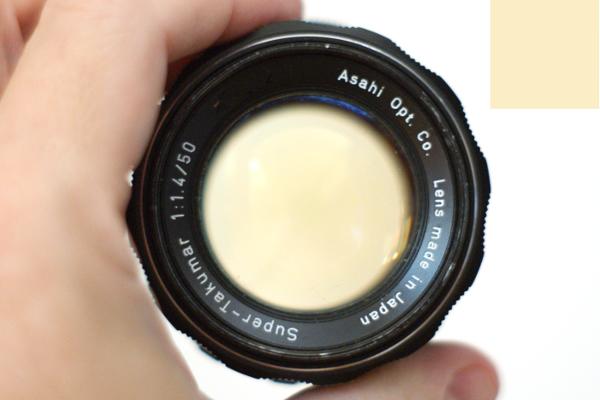
Image quality of specific lenses is a religious war I don't want to encourage. However, here are a few general rules for buying old lenses online.
If the posting or advertisement does not explicitly state the condition of a lens you're thinking of buying, ask!
Most important is clean, clear, glass. Avoid optics with scratches, fungus, haze, separation of glued elements, oil on an internal element, and similar problems. Of these, fungus is usually considered to be the worst problem, because it has the potential to infect both other lenses and camera bodies. However, none of these problems is trivial to repair. Dust inside or on the surface of the lens typically is not a major issue unless there is quite a lot of it inside the lens.
Contrary to popular belief, none of the defects listed in the previous paragraph is usually obvious and easy to diagnose by examining a moderate-resolution image captured using the lens. The primary image defect introduced by any of these problems usually is an increase in lens flare and a decrease in contrast. Dust is less severe not only because it is relatively easy to clean-up, but also because the particles typically block light rather than scattering it. In fact, an old trick for minimizing the impact of scratches and nicks involves rubbing flat black paint into them, thereby converting a potentially serious scattering defect into a minor light blocking defect. It is amazing how dirty and damaged a lens can be with virtually no impact on image quality under appropriately controlled lighting conditions. Of course, the resale value of a dirty and damaged lens is seriously degraded.
The best way to identify any of the defects discussed is to remove the lens from the camera and/or caps, clean the dust off the front and back element surfaces, and then carefully visually inspect the glass. A little penlight can help, but remember that virtually no used lens looks perfect when given this level of scrutiny -- expect to find some dust particles in even the cleanest used lenses. For most lenses, problems involving glass near the rear of the lens are much more likely to hurt image quality than apparently more severe problems near the front of the lens.
Certain lenses, such as the very popular M42 50mm f/1.4 Takumars, used materials in their glass that are somewhat radioactive. The level of radioactivity and type of emission varies more than one might expect, even across copies of the same lens model, perhaps because the amount of contamination by daughter products can vary, and each daughter has its own radioactivity profile -- some are much hotter than their parent. Although radioactivity levels are much more stringently controlled now, adding similar materials to glass still is commonly used to control the index of refraction, thus enabling superior lens designs. In normal use, the radioactivity in old consumer (as opposed to military) lenses is not a significant safety issue, but these lenses often are seriously yellowed. This yellowing isn't necessarily just a color issue; I have at least one example in which curing the yellowing dramatically improved both response of the focus sensor and image sharpness. In the photo above, the square in the upper right is a sample of the color seen looking through the center of the lens. Exposing the glass to a strong UV light for a few days to weeks generally will remove most, if not all, of the yellow tint.
The aperture control also needs to work. If the lens aperture is going to be controlled by the camera (i.e., has an auto diaphragm), the aperture has to work quickly and smoothly. However, for stop-down metering, the aperture just has to work; speed is not critical and a tiny bit of oil on the diaphragm might not be a serious defect. This is especially true of preset lenses (discussed below). Of course, focus also needs to work and the lens should be structurally sound, i.e., no pieces missing, loose, or rattling around inside. Incidentally, a dent in the filter threads isn't serious except in that the way most lenses get disassembled for cleaning involves unthreading the retaining ring around the front element... which often is held in place by having been screwed all the way down the filter thread, so a lens with a damaged filter thread might not be able to be disassembled for cleaning.
Again, it is worth noting that none of these defects will be obvious in a moderate-resolution image captured with the lens. These problems are most easily discovered by actually taking the lens off the camera, looking at and through the glass, and working the various controls.
Relatively new used lenses often are being sold for a reason that has something to do with usability or image quality of the lens, whereas old lenses are often well-kept treasures from estate sales, people who got incompatible new digital cameras, etc. It's been my experience that younger lenses are more likely to have fungus or other serious problems than are older lenses. I'm not saying you should avoid the newer stuff, just don't expect bargains and carefully check everything as soon as you get it. You might have been able to buy that $300 lens for $10 because it has fungus... which will possibly infect and seriously damage your $1,000 DSLR and all your other lenses.
Modern optics are computer designed, often use aspherical elements, and have highly effective multi-coating... all of which was rarely done 40 years ago. Wide-angle and zoom lenses are difficult optical engineering problems, and modern solutions tend to work better than old ones for these types of lenses. For example, although the vast majority of the old lenses I've tested were designed for full frame, I have seen only a few 30+ year-old lenses under 50mm that can compete at maximum aperture with the corner sharpness of a typical modern wide-angle "kit" zoom on an APS-C sensor. I have no old lenses below 24mm that are optically superior to the Sony E OSS 18-55mm f/3.5-5.6 kit zoom that came with my NEX-5. It is hard to find -- and you wouldn't want -- most wide-angle zooms built using 40-year-old technology.
On the other hand, manual focus lenses were often built with relatively simple metal housings and very tight mechanical tolerances that were largely sacrificed to make auto-focus work in newer lenses, so older manual focus lenses can be expected to be less subject to wear and breakage and often have their optical elements in better alignment than more modern lenses. Normal and moderate telephoto lens designs tend to be very simple and have not changed much. The result is that, in general, you can expect prime (non-zoom) normal and telephoto lenses from years ago to be relatively good thanks to their construction quality, whereas newer lenses tend to be better for zooms and very wide-angle lenses because they use better designs and aspherical elements.
Of course, there are exceptions; some very old and simple designs are remarkably good even for hard-to-solve optical problems. You can find reviews of specific old lenses on the web at places like pentaxforums.com, m42.artlimited.net, and various other sites easily located by searching the WWW. Keep in mind, however, that informal reviews of old lenses often are favorably biased. My collection of lenses is listed here, along with other information and pointers to my reviews of the lenses at various public sites.
Good anti-reflection lens coatings were not consistently used until the 1970s, and effectiveness of the coatings has continued to improve. It often is not immediately obvious what coatings a lens has, but most coatings will cast a visible color-tint on reflections seen from the lens surface. On a few lenses, the inner elements are coated, but not the front and rear surfaces of the lens. A lot of old lenses are marked "MC" if they are multi-coated (although "MC" also has been used to mean meter coupled), and nearly all modern lenses are multi-coated.
What problems can you expect to see without good multi-coating? Honestly, in my experience, the problems are not as severe as one would expect. However, older lenses often do have some trouble with reflections, flare, low contrast, and lower transmisivity.
Before there were auto diaphragm lenses that the camera would stop down to the taking aperture when you press the shutter, there were preset lenses. Preset lenses are designed to allow a user to focus their SLR with the lens wide open, yet quickly manually close the aperture to preview depth of focus, meter, and take the picture. Typically, a preset lens has two aperture rings, one with click stops that you set for the taking aperture and the other that you can freely turn between wide open (for focus) and the aperture pre-set on the other ring.
There are significant design constraint differences between the various types of aperture controls that allow different blade contructions. Auto diaphragm lenses must be able to open and close the aperture quickly with little force, and meter coupling mandates equal rotational spacing between aperture stops. Without these constraints, preset lenses usually have much more circular apertures, often with a dozen or more blades. This gives much more desirable rounded artifacts in the bokeh and flare patterns, rather than the shapes typically seen with the five to eight blade apertures common in newer lenses.
For most adapted lenses on DSLRs, you are forced to do stop-down metering and preset lenses are slightly more convenient than those designed with an auto diaphragm that your camera cannot trigger. Of course, if you are using an electronic live view or EVF (electronic view finder), it can be perfectly reasonable to focus while stopped down. Personally, I prefer to focus wide open with most lenses even using an EVF because the reduced DOF (depth of field) allows more precise control of the focus position. However, focus done while stopped down gives you the benefit of seeing the actual DOF and exposure information before taking the photo, and also avoids the shift in focus point that some lenses suffer upon stopping down.
Thus, all else equal, you probably will prefer a preset lens over an automatic diaphragm one. Incidentally, an automatic diaphragm lens that doesn't have an auto/manual switch is even more of a pain to use, or you can do a little modification that makes it manual. These issues, and the modification, are discussed in my "instructable" M42 Lens Aperture Control on Modern DSLRs.
It should go without saying that a lens that doesn't have an aperture ring and expects the camera coupling to set the aperture is truly painful to use on a camera that doesn't know how to operate the coupling. An old example is the mount used in the (rare) Kiev-10 and Kiev-15. These early auto-exposure SLR cameras used an internal mechanical coupling to adjust the lens aperture; without an external aperture control, they don't adapt well to other bodies. More modern examples using electronic aperture control abound, including all Canon EF and EF-S lenses.
Most mirror lenses don't have a way to adjust the aperture, so don't worry if you don't see an aperture ring on one of them. You're not losing any functionality the lens had on its native mount.
Although I have tried to stay out of "religion issues," as I read this document in 2011, I see my Sony/Minoltan faith leaking through. Don't be biased by that sort of thing when buying glass -- I'm not. My favorite lenses are a nice mix that has Sony/Minolta glass in a minority. Why? It's all about price and performance of specific lenses.
There is no one brand that magically does everything better than everyone else. If there were, there wouldn't be anyone else. One of the best things about modern cameras using old lenses is that, especially with the mirrorless bodies, you can freely pick the best lenses from many brands and mounts. I've rarely seen a terrible lens from a major camera maker, although I've often seen terrible pricing for them. I also have sometimes seen better lenses at lower prices from the likes of Vivitar, Spiratone, and Samyang. It varies, but brand loyalty can cost you dearly in price/performance.
For example, I am definitely not a "true believer" in Canon optics. In fact, to me, it seems Canon has long been the leader in using engineering to minimize cost of their consumer products while keeping quality consistently just good enough. Giving letter grades, most Canon lenses I've tested were B in optical quality, not the mix of A, B, and occasional C typical of most brands. However, two of my A+ lenses are Canons: FL 55mm f/1.2 and FD 24mm f/2.8 S.S.C. Each of these two lenses cost me significantly less than the lenses they compete with. The point is that if I had let my bias against Canon's consumer optics color my opinions, I'd have missed these two really outstanding lenses.
In summary, keep an open mind. The total cost of membership in each "religion" is usually just a one-time fee of about $20 for the mount adapter.
The answer is not necessarily yes, but usually is yes. In fact, it is fairly common that lenses that were not very good for film work great on digital cameras. There are at least three types of defects that were really bad for film but can be repaired by simple digital processing: low overall contrast (by curves adjustment), well-defined transverse chromatic aberration (by separately scaling color channels), and pincushion/barrel distortion (by interpolation using the inverse mapping).
One of the nice things about older lenses that were good for film use is that the light sensitivity of film used to be significantly lower than what digital camera sensors deliver today. ISO 25 or ISO 64 used to be the standard for color film, and fast films were around ISO 400. Thus, relatively fast lenses (large aperture, small f/ number) were often necessary and were quite common. Fast lenses give you a brighter viewfinder image, allow photos to be captured in poorer lighting, and also give the option of using very narrow depth of field (DoF) to generate beautifully creamy bokeh. That's all good, and has a lot to do with why so many people love old lenses. It also doesn't hurt that old lenses often are much cheaper than new ones.
In general, there are four major issues that can make a good film lens less good for digital: crop factor, bad things that happen in the mirror chamber, incident angle issues, and spectral sensitivity issues. The crop factor issue is easy to anticipate, the other three problems really can't be predicted -- you discover them by trying the lens.
Although there are exceptions, most digital cameras use sensors that are significantly smaller than full-frame 135 (the real name for "35mm film"). The tiny sensor in the Pentax Q has a 5.6X crop factor. The 4/3 and micro 4/3 mounts have a 2X crop factor. Canon has a 1.6X crop factor for their APS-C DSLRs, while Nikon, Sony, and Pentax APS-C have just a 1.5X crop factor. These do not change the focal length of the lens mounted, but do tell you how the angle of view changes. For example, a 50mm normal lens on a 1.5X crop DSLR has the angle of view of a 75mm portrait lens, but it still has the same DOF properties as if it were on a full-frame camera. If you've only used a cropped DSLR, you're not likely to be surprised by how things look; if you've used full-frame film a lot, your favorite film camera lenses will not behave like you remember them. For example, on 4/3, your favorite old 28mm wide angle suddenly turns into a slightly long and slow normal lens with way too much DOF. Of course, the same effect helps long telephoto lenses, which seem to get longer without getting slower; an old Canon FL 55mm f/1.2 would behave a lot like a 300mm f/1.2 if mounted on a Pentax Q!
It is worth noting that the crop factor is responsible for quite a few lenses that are not great on film being very good for DSLRs. People often talk of the "sweet spot advantage" -- the idea being that most lenses are better in the image center than at the edges, and a crop factor essentially removes the edges. If you're one of those folks lusting after a full-frame sensor to recover the full view angle from your old glass which is so wonderful on APS-C, just be warned that image quality at the edges might be pretty terrible on a full-frame sensor. Even if it isn't terrible, image quality will be much more variable across the full-frame sensor for most lenses than it is using only the central APS-C crop. The same goes for using a focal reducer with an APS-C sensor to recover that full-frame view....
Ok, I'm exaggerating. However, a lot of bad stuff can happen in the mirror box. First off, as mentioned earlier, DSLR sensors generally reflect a lot more light than film does. This means it is easy to have reflections bounce between the sensor and the rear surface of the lens, especially if that surface is relatively flat and uncoated. Actually, light can bounce off any and all elements of the lens or even a protective filter you put in front of it; flat protective filters are a known source of sensor reflections, which is why you sometimes hear about meniscus front elements. The second issue is that, on cropped sensor cameras, using lenses designed for full-frame means sending light a lot of places your DSLR's sensor isn't. That can mean a lot of stray reflections or, if your camera's mirror box is well masked, it could mean a slight rectangular reshaping of your lens exit aperture. I have seen and measured all these effects, and they really do happen... but fortunately they have never been terribly visible problems for any lens+DSLR combination that I've tested.
This class of problem is more serious for larger sensors than for cropped ones. Many film lenses have image circles that get very dark as you get farther from the center. That was ok with negative film that had huge exposure latitude, but light falloff is much more serious with digital sensors that have smaller dynamic ranges. This problem is aggravated by another aspect of digital cameras: fill factors. The light-sensitive portion of a pixel is not 100% of its area, so a micro-lens array often is used to focus light from each pixel's area onto the portion of that area that really is light sensitive. The problem is that these micro-lenses assume light is coming straight in, which it isn't at the edge of the frame, especially for some wide-angle lenses. The result is even more light falloff than for film, because the micro-lenses actually divert the light away from the sensitive part of the pixel. Chromatic abberations also can be emphasized by this same mechanism.
Another issue has to do with the fact that digital camera sensors tend to have spectral response curves that have significantly more sensitivity outside the normal visible light range than was common with film, especially in the near infrared (NIR). There is also some ultraviolet (UV) sensitivity, but it's typically less, and ordinary lens glass blocks a lot of UV light. Although most digital cameras incorporate NIR-blocking filters, the NIR leakage still commonly produces much more response than there was with film. In fact, many films have relatively bumpy spectral response curves compared to sensors used in digital cameras, so just getting the peak colors in focus used to be good enough. If the lens wasn't designed explicitly to bring the complete, wide, spectrum into the same focal plane, the result is that the sensor will detect the blurry colors and thus show various evil color fringes: chromatic aberrations.
This difference in spectral sensitivity seems to be the explanation for various people's complaints about how a lens that they happily used on film suddenly seems to have serious chromatic aberration (CA) issues on digital bodies. Some types of CA can be partially corrected in digital image processing, and there are now DSLRs that have this correction built-in for lenses they recognize. However, the real fix is to design the lens to produce a flat focal plane for a spectrum better matching what the sensors detect, and that certainly wasn't done for old lenses. Some DSLRs have better NIR-blocking filters than others, and the trend is definitely toward stronger filters, so expect the level of CA seen to be a function of the camera body as much as it is one of the lens.
As a rule, the better a camera is for NIR photography using a visible-light blocking filter, the worse lens CA is likely to appear. This is especially true for the dreaded Purple Fringe (PF) CA, which is mostly caused by NIR light not focusing in the same plane as visible. If the lens has an "IR focus adjust" mark on the depth-of-field scale, the size of that shift is a pretty good indication of how wide the PF could be.
All types of CA also tend to look worse on higher-resolution cameras because smaller pixels mean the same spatial blur is spread over more pixels.
Some of you reading this may have been smart enough to do so before you've purchased a digital camera body. If so, you might want to pick one that will make it easy to use your old lenses. If your lenses are auto-focus, the latest DSLRs from the same manufacturer are the ones most likely to work. Most lens mounts from the days of manual focus SLRs are essentially orphans. The EVIL mounts are all new, without any old lenses available in their mount, but most old lenses trivially can be adapted because the mount-to-sensor distance on EVILs is smaller.
Originally, I had written this section describing DSLRs. However, Sony's 2010 introduction of the A33 and A55 really messes-up the taxonomy. These cameras have a mirror that doesn't deflect light to an optical viewfinder, but to the phase-detect autofocus sensors. Technically, they are not DSLRs, but EVILs, because the live view is electronically derived from the sensor. On the other hand, they do have a mirror box and hence use the same lens mount as a traditional DSLR. In summary, for the purposes of adapting old lenses, these pellicle-mirror EVILs behave like DSLRs.
Here's my rough brand-by-brand summary for the mounts used by digital cameras with mirrors (mostly DSLRs):
None of the above cameras come with focus aids in their viewscreens, but it is a manufacturer or third-party option on most models. If you're serious about using manual-focus lenses, you should seriously consider getting one of these screens.... Of course, sensor live view is a good option where available.
The following three paragraphs are the personal opinion and suggestion of this frustrated Sony DSLR user, just in case any Sony engineers are listening.
Ironically, whereas Minolta's good handling largely came from making camera controls directly accessible rather than burried in menus, Sony seems to be removing controls while keeping features out of menus. How hard would it be for a firmware update to allow Sony DSLRs to have menu items that would make chipped adapters unnecessary, thus making the Sony full-frame cameras with their SSS anti-shake become the choice for using old lenses? This would also partially remediate the problem of having too narrow a mount; for example, the rear element of the modern Samyang 85mm f/1.4 is too tight a fit for a chip to be mounted easily, so this lens gets no focus confirmation nor SSS -- this chipless lens is much more useful on the similarly cramped mount of a Pentax. Rather than having a menu item (like the A100) that says "allow shutter to fire without a lens," why not have an "assume the following focal length if no lens is detected" menu item and allow the user to set the aperture for the "no lens detected" using the usual control (affecting only EXIF info, not exposure)? Ideally, I'd want the body to remember the last few lens data used in no-lens-detected mode, and let me pick one of those or enter a new one. Of course, Av mode should also work on all Sony DSLRs with no lens detected... at least like it did in the A100. The "focus priority" setting also should work as trap focus during manual focus, especially when no lens is detected.
Sony deserves credit for trying some truly new ideas in the A33 and A55. I absolutely love the EVF -- but hey, I even liked the Sony F828's EVF. I'd like to see these new pellicle mirror EVIL/DSLRs have a mechanical mirror lock up switch, which understandably would require disabling the phase-detect focus sensor. One reason is that I'd like to be able to get that 1/3 stop of light back when necessary, also removing a potential source of internal reflections and dust shadows. The other, more relevant to this document, reason is so that I could safely mount lenses that extend very far into the mirror chamber.
Finally, ever since the firmware upgrade gave my NEX-5 "focus peaking," I don't think any live display nor EVF camera should be without it. You don't need to have contrast detect autofocus to do this, just reprocess the display image for it. This could even be done in my old A350 via a firmware update. It is borderline insane that the A55 didn't get this feature in the same firmware upgrade that gave it to the NEX-5.
The very short back focus enabled by using the sensor for live view, rather than reflecting an image through an optical viewfinder, makes EVIL cameras the universal acceptors of old lenses using glassless adaptors. There are no "old" lenses with the new EVIL mounts, but adaptors are generally easy to make and often quite inexpensive. The other interesting aspect is that EVILs seem to be an excellent starting point for development of HD camcorders, largely toward using old lenses to make new movies with nice bokeh.
Incidentally, again in 2011, Sony has messed-up the taxonomy by announcing an adapter for their latest NEX cameras that adds an SLT mirror and phase-detect autofocus. Cool. Nice to see somebody is trying to explore the full design space for computationally-enabled photography.... ;-)
There's a very funny, but rather insightful, video overviewing some of the major mirrorless choices at http://youtu.be/LO7rxitFLZg. Here's my rough brand-by-brand summary for the mounts used by digital cameras without mirrors (many of which don't actually have a viewfinder per se, but instead use a rear display panel):
In summary, new EVIL mounts really seem the clear way to go for use of old lenses. The only downside is that you're looking at an electronic screen rather than an optical image. However, a good EVF (electronic viewfinder), like that on the Sony A55, is frankly far superior to an optical viewfinder for old lenses. Why? Stop-down metering. When stopped down, optical finders become uselessly dark, whereas an electronic display simply turns-up the gain and lets you see the full impact of DOF, etc.
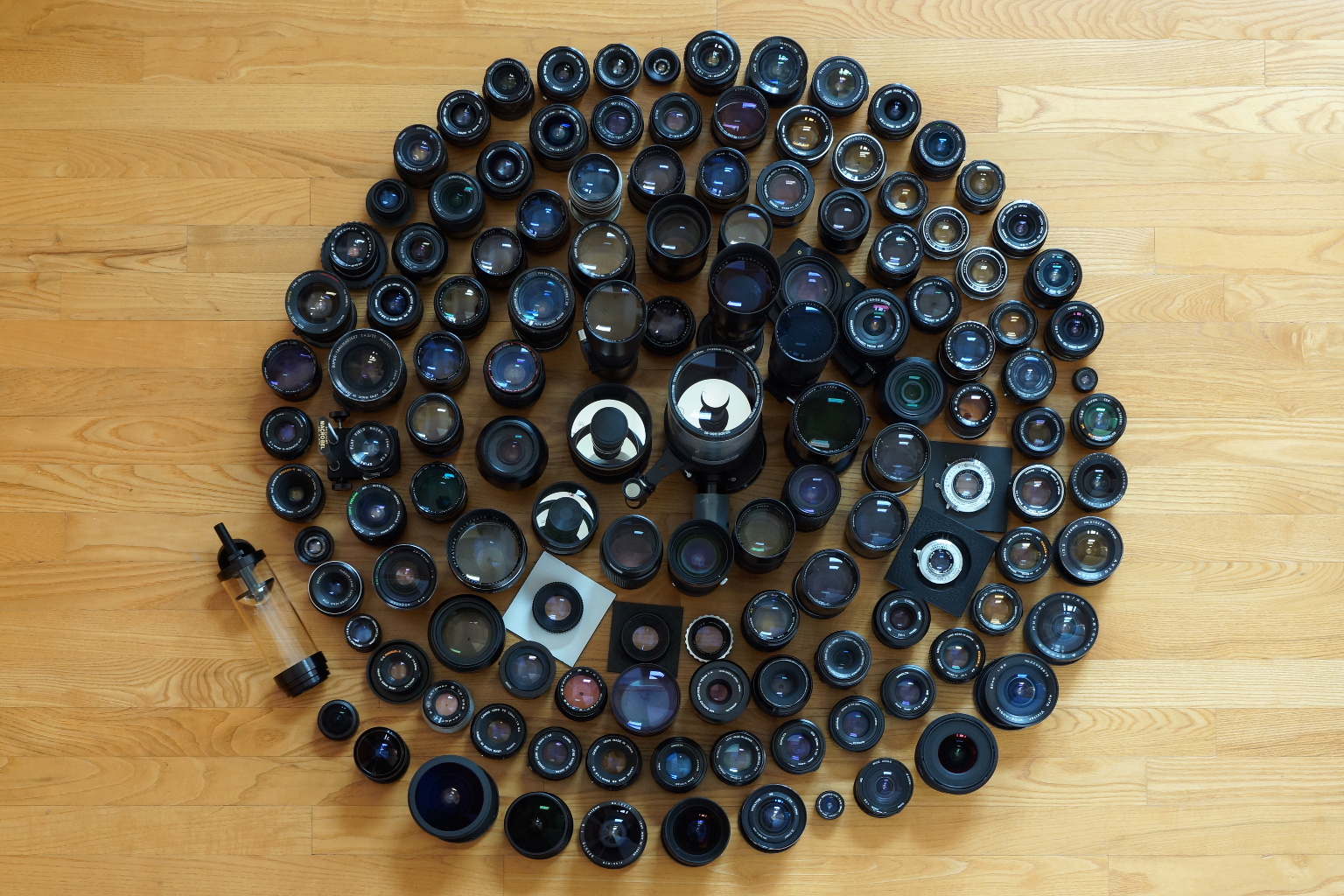
Old manual focus lenses are highly addictive. The first time you pick one up, the mechanical quality hits home. Then you turn the focus ring. Wow! That sure felt good. Unbelievably smooth. Then you make the really big mistake. Thinking manual focus is cool, you try turning the manual focus ring on your favorite auto-focus lens. What the H*LL was that? Sloppy. Plastic. Yuck! The next thing you know, you've got a dozen old M42 lenses sitting next to you.... It's called LBA: Lens Buying Addiction.
Ok, all kidding aside, I've got too many old lenses. However, it is because I'm trying to get a specific set of lenses and lenses often travel in groups. If you can get the lens you want at a reasonable price and it happens to come with three others you didn't want (or didn't know you wanted), that's ok. You can always pass those extras on to another addict, and you probably will not lose any money in the deal. In fact, I spent less than $300 on M42 lenses to get the entire collection shown here (except for the 55mm f/1.8 Super Takumar, which I've had since it was new). As of 2013, I've got over 125 old lenses and they cost an average of under $30 each, including shipping. That said, there are a lot of addicts and dealers on ebay who are pushing the prices beyond reasonable limits -- used lenses from respectable camera stores (e.g., KEH) often are significantly cheaper than you can get them on ebay!
In summary, think about what lenses you really want and stay focused on buying them at reasonable prices. I strongly recommend reading reviews of lenses you are thinking about buying before you buy them, although you should be aware that there is often a positive bias in user reviews. If you don't know what you want, get a fast normal lens (50mm-58mm and f/1.2-f/2.0) and play with it for a while. After that, I think a 135mm telephoto lens is an obvious choice because that was usually the "kit" telephoto focal length, so they're fairly good and widely available at bargain prices. Extension tubes for close-ups also are great to have, and even new manual tubes can cost less than $10. A 28mm or 35mm lens was usually the "kit" wide-angle, and they're ok, but keep in mind that newer wide-angles are at least as good. As for more lenses, well, figure out what kinds of photos you want to take and get the lenses that will help you make those photos. Remember that the photographer creates the image, the camera and lens are just there to help.
Another problem happens when you have lots of lenses that you like: you tend to become a heavy user. The problem with that is you end up changing lenses a lot, and M42 screw threads take a while to screw in and out. That means your DSLR will be collecting dust on its sensor an order of magnitude faster than it used to. Dust wasn't such a problem with film, because the act of advancing the film tended to scrape the dust off (or at least push it to the edge of the frame). I'd also suggest avoiding macro belows entirely, because they seem to be the ultimate dust infusers. Buy yourself a good dust blower and get used to regularly checking your sensor for dust and blowing it off (here is a bit more about cleaning). Dust is most visible at small apertures, so it also can help to avoid using f/16 and higher for your photos if you're not 100% sure your sensor is clean.
There are lots of relevant things on the WWW; here are a few.
 The only thing set in stone is our name.